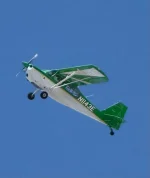
7ECA vs 7GCAA

Derek Lawless

Well-known member
Joined
Dec 24, 2024
Messages
102
Location
Fishers, IN
Pondering moving from a 7GCAA to a 7ECA rebuilt by ACA in 2020. Mostly interested in reducing costs of capital tied up in machines, insurance due to lower hull value and cutting fuel consumption. Plane would be primary tailwheel trainer. The GCAA has a climb prop and climbs around 1100-1400 ft/min at gross in the heat from 1000MSL. Will I be sorely disappointed in ECA’s performance?
 
Depends, I almost bought a 7GCAA before I bought my 7ECA. I bought the 7ECA because it checked my boxes, was overall in better condition and had a better useful load. The 7GCAA got off the ground quicker and climbed better. The 7ECA doesn't get off the ground quite as quick, or climb as well, but it's not bad (much less ass puckering than my Champ was on a warm day with someone in the back). Our strip is at 1,100'. I don't have a VSI but I would guess I am realistically getting 650 - 750 fpm loaded on a warm day. It might be a bit cheaper to insure and you will use a bit less gas. My hunch for training is you would trading performance for the ability to train someone 40-50 lbs heavier for a little less cost. I would try to find one and take it up to see if it fits your needs. Good luck!

Pete
 
The GCAA is an ECA with metal spar wings and 160 Lyc. There may be slight fuel routing and quantity differences but that's it. Ray Redmond told me the GCAA is the best Champ, period.

Kermit is an ECA converted. It keeps the ECA data tag, but might as well be a GCAA. stunning performance!

Kermit.webp
 
Last edited:
I used my 115hp 7ECA for TW and Spin training for ~15 years. ~ 5 years ago the 0-235-C1 went to crap and I exchanged it for a 0-320 150 HP. So basically went from a 7ECA to a GCAA.
The 7ECA was superior to the GCAA as a TW trainer.
The biggest advantage was that it had a longer ground roll on TO so the student had time to make and correct mistakes. It also had more useful load. I lost 30 pounds even with going to light weight starter, alternator and little battery.
The only advantage the GCAA had was climb, getting back to altitude after a spin. Hardly made any difference in training time.
I saw almost no difference in fuel use, both used ~ 5 - 6 gph when training. I ran 22 - 2300 rpm in the GCAA, barely 50% power for an airspeed ~110mph.
I personally liked the extra HP; however.
 
Impressive! That is way better than I did with the more efficient by a bunch 160 conversion. But see above for climb angles!

Yes the little 115 hp would be a better trainer for tailwheel transitions. I have done one student from zero in one.

On the GCAA, or a metal spar earlier ECA with 160, do not forget that you do not have to do the spar AD every year. I don't know how you guys do the spar inspection, but it takes me the better part of a day, and that is on an aircraft that I know intimately, and that has not hit any fenceposts.
So with the GCAA or an ECA clone, you save maybe $600 per year in inspection cost (assuming you have a shop do the inspection). That might offset insurance differences?
 
So Derek - was the ECA converted to ACA metal spar? That gives you options down the road. You cannot have a 160 on the Milman conversion without a field approval.
 
So Derek - was the ECA converted to ACA metal spar? That gives you options down the road. You cannot have a 160 on the Milman conversion without a field approval.
They said it has metal wings, but I haven’t had a chance to read the logbook yet to see if they milman or factory. It was supposedly rebuilt by the factory in 2020 so I’m guessing that it’s Aca Wings. My GCAA is a 2001 with 160 hp and it’s got a climb prop so we get 12 to 1400 ft./min..
 
Agree with what has been said here. ECA for tailwheel training I do like better. If doing spin training the climb time will probably negate the fuel savings. What about overhaul costs of the -235 vs -320?

I might switch for condition of the airplanes vs each other but not sure I'd switch just based on one model being better for the job than the other and then there is the engines vs each other for long term care and feeding vs fuel savings. Maybe a case of pay now or pay later. Tough call but if just for tailwheel training only, its hard to beat the ECA
 
I would say that is a winner, depending on price.
As a benchmark, the one I was associated with was in the $70-90k range. Once I got it here the owner had to sell - but to another friend.
If I did not value the inverted system I would have swapped even. And I am not partial to green airplanes.
Cover was good, engine was 1000 or so since factory new, interior impeccable, new tailwheel assy.

But for training the ECA with lighter engine is the real winner. The J3 is better . . .
 
Back
Top