ADSB In portable

Joesf

Well-known member
Joined
Nov 12, 2018
Messages
57
I’m looking at portable adsB IN units . I have a skybeacon on my 7GCAA. Since I use Fly Q I’ve narrowed it down to a Dynon DRX or a Status 3.
The DRX is smaller and has a 16 hour battery life, no AHRS. The status 3 is larger and has AHRS. Does any one hVe experience with either of these?
if so how well do they work?
 
Last edited:
I have a Garmin GDL-50. Works good but only if you use Garmin Pilot. It has AHRS, but I'm not sure whether I would trust my life to a bluetooth connection enough to actually fly on my tablet/phone. If you have a USB or 12v jack then longer battery life may not be the deciding factor either.

I don't pay much attention to ADS-B Traffic, but Weather is a game changer for XC.

Nothing more frustrating than having trouble connecting to your phone or table, so I recommend you go with whatever one of your options has better reviews for ease and simplicity of connecting to your display.
 
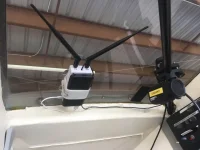
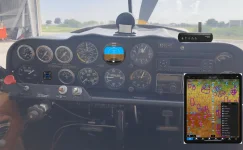
I took the low tech ADS-B "in" route with a Stratux mounted suction cupped to the underside of the skylight.

104812711_1654664184692483_3990221474124540354_n.jpg

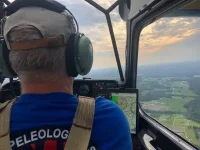
The output is in the form of a 9.7" iPad with Flight Plan Go.
75462288_1660598657432369_8974754474713197945_n.jpg

The traffic information is useful, but it doesn't replace looking outside for traffic. At best, it gives you a good idea of where to scan for those aircraft with ADS-B "out". But it does nothing to help you spot those aircraft that are not ADS-B "out" equipped or have an inoperative ADS-B system.

It's the weather information on the moving map display that is awesome, especially this time of year with lots of convective activity and precipitation.

It's not perfect as the radar information is a radar mosaic that takes between 7 and 20 minutes to assemble, and then another minute to upload and transmit. In other words, the radar information on the screen is what and where the weather was 8 to 21 minutes ago. In VFR you can compare what you see on the screen/map with what you see out the window and it gives you a good idea how old the information is. In addition, as it updates, you can see how fast it's moving, in what direction it's moving, and how it's evolving. Even better, it lets you see on the screen/map what is behind the activity you can see out the window. It makes navigating your way around developing thunderstorms without the risk of running yourself into the metrological equivalent of a box canyon.

In IFR you don't have the visual out the window cues to tell you where it is, versus where it was, so you need to take care to stay well out in front of any moving radar images as they are 8-21 minutes old. A storm moving at 30 mph can be over 10 miles farther than it might show on the radar. Even if the mosaic is uploaded when it is only 8 minutes old that storm moving at 30 mph will have moved 4 miles by the time you see it on the moving map display.

---

The Stratux has AHRS as well. With an external antenna and 1.5 to 2 meter accuracy, (geographical) altitude and ground speed readouts are accurate, but those readouts as well as the rate of climb/descent, roll pitch and yaw data have a delay of about 2 seconds. It'll tell you what you were doing 2 seconds ago and that's fine in stable cruise flight, but I wouldn't want to fly an approach with it.
 
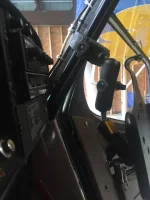
@BB57 I like your tablet mount. What kind of grip is that on the fuse frame?

It's the small version of the RAM mount claw. That was the easy part. The hard part was getting it to set low enough so that it did not interfere with the view outside the airplane, or with the view of the radio and transponder. With a couple of their short extensions and a ball to ball connector it's low enough to see the radio and transponder over the top of the iPad but high enough that you can reach up underneath to change the frequency on the com.

106172370_1661461677346067_5850622044783845024_n.webp
 
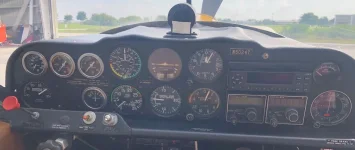
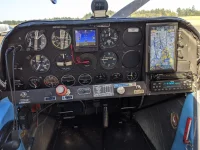
That's what I need. Here is my panel.

Photo Jul 07, 17 54 44 (2).webp

Hoping to find a tablet that fits in the space over the NAV radio and VOR, without blocking the COM radio, transponder, or EGT.


mock panel - Copy.webp
 
Here's what I'm rolling with
IMG_20200726_085939.webp
Still liking my Dynon D3. The ADAHRS feed from my Stratus is worthless for anything other than straight and level flight because of the lag indicated by others here. It would kill you for sure in IMC.
 
Hmmm, I'm going to look closer at that D3. Way more cost effective than spending $3K to install a G5 or RCA. Superior to GDL-50 because it does not rely on bluetooth connection to unstable display device. I don't have an open 3" gauge hole for the pinch mount, but I can suction cup it to the G meter for XC.

I really like that solution because I don't have to molest my TC with that big ole' ball right in my line of sight and directly on the center line of the aircraft. That really is the optimal setup for acro. D3 could be the best of both worlds.

Have you tested it out enough to be confident in it's accuracy and responsiveness in IMC?
 
Hmmm, I'm going to look closer at that D3. Way more cost effective than spending $3K to install a G5 or RCA. Superior to GDL-50 because it does not rely on bluetooth connection to unstable display device. I don't have an open 3" gauge hole for the pinch mount, but I can suction cup it to the G meter for XC.

I really like that solution because I don't have to molest my TC with that big ole' ball right in my line of sight and directly on the center line of the aircraft. That really is the optimal setup for acro. D3 could be the best of both worlds.

Have you tested it out enough to be confident in it's accuracy and responsiveness in IMC?
I'm going to answer that carefully. Dynon claims that the D3 contains the same "guts" as their bigger displays. Its display is very fluid and the resolution is more clear than the demo units I saw prior to buying mine. But read on.

My airplane is strictly VFR and it sure looks like yours is too. I'm a CFII and did quite a bit of flying in actual IMC for a while (not IFR current now and only recently interesting in pursuing currency again). The D3 isn't certifiable for IFR nor would any other device you can suction cup onto the panel.

Would it be a great backup on a panel to catch a dying attitude indicator during a cross check? Absolutely. Would I want it on my panel in the event my AI rolled over dead in IMC? Absolutely. Would I enter IMC with this device as my primary indicator? Oh hell no.

Here's why. First off I already gave my opinion about ADAHRS derived attitude. It flips out during a single wingover and insists I'm upside down long after I've returned to wings level. Beyond that, it lies in two axes.

Pitch:
If you're flying along in unstable air, wings level and nose on the horizon, and enter a down draft the indicator will show that you are pitched down. It's not. Your nose is level.

In IMC if my attitude is level but I see a downward trend on my VSI and altimeter I will know I'm in a downdraft and that it will probably come right back up if I stay the course. If I show a downward pitch attitude plus VSI and altimeter it would take a steady hand and a good scan to see that the airspeed hasn't changed and to not chase gauges. It might even cause someone to suspect their airspeed indicator is lying.

Roll:
Taxiing on the ground and you turn a corner, a mechanical gyro will indicate wings level - because they are. The electronic EFIS units I've flown with, including the D3, will show a bank. But I've got all three tires on the ground and it's level. I have no explanation why anyone would think that was safe or desirable.

I bought the D3 for teaching students because my plane never had a real attitude indicator. For a primary student it is hard to teach them the difference between 45 and 50 degrees of bank, or what 7 degrees of pitch looks like unless there's something to refer to. The speed is GPS ground speed so it's important to point out that it is reference only, and useful only for judging winds aloft.

No regrets buying the D3. It's a great device. IMC? no.
 
Ok, thanks. My airplane and I are strictly VFR. However, I plan to do a good bit of XC over the next year or two. I do not intend to fly into IMC on purpose. However, I know myself well enough to know that I will wind up making the last hour of some return flights in the dark. I will also probably go over the top of a low cloud layer sometimes when I am comfortable that it is clear at the destination. That means I need to be prepared to deal with inadvertent flight into IMC. Not prolonged flight, but enough to do a U turn or descend thru a thin layer such as below.

To me that means an AI. But I have no vacuum and am not going to. I also plan to do a lot of acro and I tend to fly hard, which is not good for gyros. The obvous solution is an electronic AI.

Do certified panel mount electronic AI options such as the G5 have the same pitch and roll indication issues that you describe with the D3?

I do not trust the portable options I have seen, mainly because they rely on bluetooth data connections and unstable phone/tablet displays. Too many moving parts and processes to fail. I like that the D3 cuts out some of that.

So let me reformulate the question: if you put yourself in a bad spot while flying VFR, would you be comfortable with the D3 to get you out of it, or would you wish you had spent an extra $2K on a certified electronic AI?

IMG_20190208_163557.jpg
 
Ok, thanks. My airplane and I are strictly VFR. However, I plan to do a good bit of XC over the next year or two. I do not intend to fly into IMC on purpose. However, I know myself well enough to know that I will wind up making the last hour of some return flights in the dark. I will also probably go over the top of a low cloud layer sometimes when I am comfortable that it is clear at the destination. That means I need to be prepared to deal with inadvertent flight into IMC. Not prolonged flight, but enough to do a U turn or descend thru a thin layer such as below.

To me that means an AI. But I have no vacuum and am not going to. I also plan to do a lot of acro and I tend to fly hard, which is not good for gyros. The obvous solution is an electronic AI.

Do certified panel mount electronic AI options such as the G5 have the same pitch and roll indication issues that you describe with the D3?

I do not trust the portable options I have seen, mainly because they rely on bluetooth data connections and unstable phone/tablet displays. Too many moving parts and processes to fail. I like that the D3 cuts out some of that.

So let me reformulate the question: if you put yourself in a bad spot while flying VFR, would you be comfortable with the D3 to get you out of it, or would you wish you had spent an extra $2K on a certified electronic AI?

View attachment 2581
For the scenario you describe the D3 will do fine. I didn't mention it, but it also has synthetic vision. So for those night flights it helps back up the old mark 1 eye ball.
 
For the scenario you describe the D3 will do fine. I didn't mention it, but it also has synthetic vision. So for those night flights it helps back up the old mark 1 eye ball.

Great, thanks! Looks like a perfect solution at a good price. Now I don't have to molest my OEM panel.
 
AftCG's input is important because details in instruments and understanding how they actually work matters.

For example my 7KCAB has a Turn and Bank Indicator (T&B) and its inclusion by the factory was very intentional, even though the more modern Turn Coordinator (TC) was available. A T&B, when properly mounted level to the aircraft's longitudinal axis, will show the direction you are yawing in all the time. That's useful in a spin recovery as if you ever become disoriented, you can look at the needle and then apply full rudder in the opposite direction. It works upright or inverted and regardless of if or in what direction the aircraft might also be rolling.

One of the problems with T&Bs back in the day was if they were mounted in an angled panel where the instrument panel was angled so that the top of the panel was forward of the bottom, the T&B would show a yaw in the wrong direction each time that the aircraft rolled in one direction or the other. That's actually where the idea of the TC was conceived. Someone figured out that if a T&B was placed in a panel that angled so that the bottom of the panel was forward of the top, it would indicate a roll in the correct direction as well as yaw. As a result for early autopilots, sensing for roll was accomplished by using what was basically a T&B with the gyro angled 45 degrees so that the front was higher than the rear, but with no indicator for the pilot. Not long after that the TC was introduced, with the same angled gyro, and an indicator for the pilot in the form of the banking airlane.

The problem with the TC is that it can't tell the difference between roll and way since is is mounted at an angle to the longitudinal axis of the airplane. When you initially roll into a turn, a TC can't discriminate between rolling and yawing. Once you are in a stable turn with no rolling motion, it will be displaying only yaw, as the rate of turn. That's fine for a 2 minute turn, but in a spin, where you may also have some rolling motion, it again can't tell roll from yaw. That's bad for a pilot who blows a spin recovery and noses over into an inverted spin, where the pilot might now be confused about the direction of the spin and the combined roll and yaw may cause the TC to give the wrong indication. In that situation the T&B still works fine and still accurately lets you know which pedal to push.

It's not a big deal in a Citabria where it takes about three seconds to rotate 360 degrees, but it's a bigger deal in an aircraft like a Pitts where a full spin rotation only takes about a half second.
 
I don't know anything about spinning on instruments. I have a Garmin 295 programmed with a glidelope and horizontal flight director. The route includes a seven mile rectangle rolling on to final roughly where the NDB was.

The aircraft has vacuum driven heading, attitude, and turn needle installed, with a shutoff valve. It has a KN53 with glide slope. Every three months I go out with a check pilot and shoot three ILS approaches. On the last one I reach down and turn the air off on crosswind. By the time I turn base, my attitude indicator says "tilt."

The flight director on the Garmin is good enough to keep me rightside up, and pitch is done with airspeed and glideslope. This has been my currency plan since 2004. Works!
 
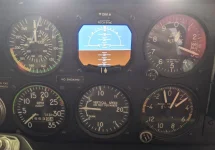
Just as a follow up on the AI vs AHRS discussion, I wound up installing the RCA 2600 AI. Felt a panel mount TSO unit was worth the expense. Got this one off eBay from Wentworth for $1300.

6 pack.jpg
 
I installed the skysensor. No AHRS, but it works fine for traffic and weather with Fly Q.
 
Both Uavionix units are working great ,they come in handy in crowded airspace .
 
The Uavionix AV30 is a hell of a product for panel mount. Wish it had been certified when I was getting mine done.
 
Back
Top