AI vs TC

Big Ed

N50247 - '79 Super D
Joined
Jul 20, 2020
Messages
1,938
Location
Tampa, FL
Curious what others here think of necessity/benefits of AI vs TC. Did I need an AI, or would I have been just fine with a TC?

I plan to do a lot of XC in my Decathlon over the next 2 years, mostly in the Southeast US. Weather here is mostly convective. I decided I wanted an AI for added safety in case of inadvertant flight into IMC. I looked at various portable options, but decided I would prefer a panel mount instrument if I could swing the cost.

My radio died last week, and the avionics shop gave me a last minute call that they could get me in the next day. At the time, I was watching a used RC Allen 2600 electronic AI that had just popped up on eBay. The price was appealing at $1300 and I really like the round gauge profile. I do not like the aesthetic appearance of square gauges like the G5, and I do not like EFIS-style devices in general. Too many numbers for my old eyes. I made a snap decision to buy the RCA while I could, and save labor cost by having it installed with the radio.
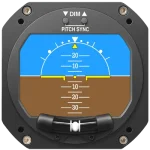
RCA2600-3 PS front.png

During research, some folks advised that I would be better off with a TC. I have no instrument training and have never flown partial panel on a TC alone, so I had no basis to judge the pros and cons. I did like the position of the TC front and center, which is where the slip skid ball should be. The RC Allen mechanical ball is half the size of the TC ball.

Right now I am having the TC removed. If I really felt I would miss the TC, I could make a spot to keep it by downsizing the Tach to 2 1/4" or moving the G-meter to the right of the radio, where the CDI was. Any thoughts on that?
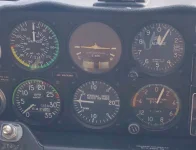
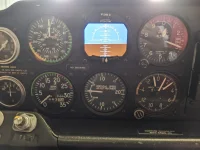
six pack.jpg
 
Don't even think of getting into a situation where you need to fly solely with reference to instruments. The aircraft is not certificated for IFR flight.

That said, I would re-arrange so that you can keep the turn coordinator. An attituge gyro and directional gyro are nice.

Is that 2600 a "stand alone" instrument? If so, you have done a good thing. Some of these things need extra expensive black boxes. Edit - I just checked - it is a gyro instrument. I wonder if its service life is longer than their standard gyros?
 
I prefer a Turn and Slip indicator to a Turn Coordinator in an aerobatic aircraft. The gyro in a Turn and Slip indicator is up right and only reacts to yaw, while the gyro in the Turn Coordinator is angled forward and reacts to both yaw and roll. The difference is that if you are in a spin, upright or inverted, the Turn and Slip indicator will always show you which way you are spinning. A turn coordinator will not as it is also affected by roll.

----

I agree with Bob that if you are not both instrument rated and current, you don't want to mess with "inadvertent" flight into IMC - AI or not.
 
That's the thing about accidents. You don't intend to do them. But they happen anyways, so you give yourself an out. That is what the AI is for me. An out if I make a bad decision and wander into a cloud.

Is that 2600 a "stand alone" instrument? If so, you have done a good thing. Some of these things need extra expensive black boxes. Edit - I just checked - it is a gyro instrument. I wonder if its service life is longer than their standard gyros?

The 2600 is electronic, like a G5. No moving parts, no spinning gyros. Service life is theoretically infinite, and almost certainly longer than my service life.

It is basically identical to a G5, except that it does not display altitude and airspeed. I did not need or want that anyways. Also, it is round.

If I had a few more bucks to blow, I would have looked hard at the GI 275. That thing is a marvel.
 
Saw a photo of a nice Citabria panel layout on FB. They put a G5 AI in the top center position, but put the TC directly below it. Makes sense to me to have both instruments on the aircraft centerline.
 
That's the thing about accidents. You don't intend to do them. But they happen anyways, so you give yourself an out. That is what the AI is for me. An out if I make a bad decision and wander into a cloud.


The 2600 is electronic, like a G5. No moving parts, no spinning gyros. Service life is theoretically infinite, and almost certainly longer than my service life.

It is basically identical to a G5, except that it does not display altitude and airspeed. I did not need or want that anyways. Also, it is round.

If I had a few more bucks to blow, I would have looked hard at the GI 275. That thing is a marvel.

Does it have internal battery backup?

Ed
 
Does it have internal battery backup?

Ed

No. It has an optional external battery, but I did not get it. I figure if I accidentally enter IMC and my electrical system fails at the same time, it was probably my time to go.

If I was buying new, or if I had made the decision now instead of when I did, I would probably have gotten the Uavionix AV-30C instead. That can be set up to function as both an AI and a DG/HSI, and you can flip between them. And it has an internal battery. And it's only $2K new. But the long awaited certification announcement for that device came out about a week after my plane went in the shop, after I had pulled the trigger for the RCA2600 on eBay.

I will say this: I have flown a few hours on the RCA2600 and it is rock solid, responsive, and accurate. I would have zero issues flying on it in IMC. As long as my electrical system doesn't quit. :)
 
Follow up: I inadvertently wandered into IMC today, and boy was I glad I had that digital AI.

I flew home from NC to FL yesterday. Weather was fantastic all the way to the FL panhandle, then it got skunky. My departure was delayed so the sun set while I was on the ground during my last fuel stop, about 45 minutes north of Tampa. When I took off again, it was dark and looked very bad ahead, could not see any ground lights. I wound up doing a 180, landing in Gainesville Class D, and sleeping on the couch in the pilot's lounge.

This morning I took off about 30 minutes after sunrise. Radar showed showers west of Gainesville, but clear south all the way home to Tampa. ATIS reported ceiling 12K and visibility 10 miles. I could see clouds on the horizon to the west, but it looked clear on the ground in the vicinity of the airfield.

However, during the time it took me to start, taxi, and run up, a low layer of clouds moved next to the west edge of the airfield. Tower assigned me runway 25, pointing right that way. I took off and started climbing, and entered white soup at 500 AGL. Didn't even see the clouds til I was in them.

Departure took me over town and numerous towers, so I did not feel comfortable ducking back under. I decided to hold my climb to pattern alt and then ask for help. I got on the AI and kept wings level and pitch 10 degrees up. Fortunately I broke thru the top into VFR about 30 seconds later. Ahead of me was a solid carpet of white to the west at about 800 AGL. I turned southeast and it was clear as a bell, so I headed home.

I probably would have fine with a TC or TnB, but only if I had practiced that situation in my plane. With the AI it didn't require any practice, just get on the instrument and stick with it.

Back in the day, adding a vacuum system and gyros was major surgery and cost major coin. Nowadays the new digital AHI's are dirt cheap (relatively) and comically simple to install. IMO a no brainer to add one.
 
Last edited:
Now file a NASA report. Free!
You reminded me - I need to file one on a hovering helicopter - not talking to anybody, 20 feet off a major taxiway. I waited five minutes for him to land.
 
Hence the usefulness of the NASA report. Still, it would be a lot of work to figure out who and where . . .
 
I'm not worried about the FAA. Current METAR and TAF were VFR. The tower couldn't see the cloud layer any better then I could. I followed proper procedures and resolved the situation safely.

I posted this to share what I consider a valuable lesson learned for our community. How many Citabria or Decathlon owners get hood time on their TC, especially on departure climb out? If you aren't 100% sure you could maintain control on needle and ball, then the new digital AHI's are a big step up in safety for minimal cost, and installation is trivial.

For about 30 seconds yesterday, I was VERY happy with my decision last fall. I'll take a little risk to share my experience with my online friends here.
 
Thanks Ed, I appreciate the sentiment and am very happy the experience had a positive outcome. Are you instrument rated?
 
Thanks Ed, I appreciate the sentiment and am very happy the experience had a positive outcome. Are you instrument rated?
Nope. One of those things I always intended to do, but something else popped up. I have done a fair amount of dual time under the hood and in actual IFR, so am comfortable flying by reference to instruments. I don't have any procedure training on approaches, departures, holds, etc.
 
Last edited:
NASA reports are for when you follow proper procedure and inadvertently break a regulation, or when you observe an unsafe situation. They do not work when you deliberately violate a reg.
And they are free!
 
I went back and checked the METAR history for KGNV.

Here is the METAR during preflight:
KGNV 171053Z 18003KT 10SM CLR 22/21 A3001 RMK AO2 SLP158 T02170211
Temperature: 21.7°C ( 71°F)
Dewpoint: 21.1°C ( 70°F) [RH = 96%]
Winds: from the S (180 degrees) at 3 MPH (3 knots; 1.5 m/s)
Visibility: 10 or more sm (16+ km)
Ceiling: at least 12,000 feet AGL
Clouds: sky clear below 12,000 feet AGL

And here is what it changed to when I took off:
KGNV 171126Z 19005KT 10SM BKN010 22/21 A3002 RMK AO2 T02220211
Temperature: 22.2°C ( 72°F)
Dewpoint: 21.1°C ( 70°F) [RH = 93%]
Winds: from the S (190 degrees) at 6 MPH (5 knots; 2.6 m/s)
Visibility: 10 or more sm (16+ km)
Ceiling: 1000 feet AGL
Clouds: broken clouds at 1000 feet AGL

Flightaware shows my first ping at 1129Z at 595 feet altitude. That would be roughly one minute after wheels up. Which means the weather observations changed literally as I was taxiing onto the runway.
 
Last edited:
As I further process this event in my mind, I am developing some strong opinions about various AHRS solutions.

BLUF: any AHRS solution which involves any of the following situations is unacceptable for in-flight use:
  • Any device which depends upon a wireless connection to another device to show attitude
  • Any device not permanently mounted and hardwired into ship's power
  • Any device with options to change the view so that AI is not displayed
  • Any device which must be calibrated or sync'd to aircraft attitude in flight or prior to takeoff
IMO the only acceptable AI solution is a permanently mounted device that is always connected, always on, always calibrated, and always shows attitude.

With any other device, there is a non-zero probability that you will have forgotten to charge it, forgotten to mount it, forgotten to connect it, forgotten to turn it on, forgotten to sync it, or forgotten to switch it to the attitude display.
 
Back
Top