Avionics Master

I need to disagree a bit on the 337. You need 337s for major repairs and alterations. The regulations explicitly exclude things that are on the type certificate.
My impression is that that means if the factory is delivering aircraft equipped with breakers, props, or engine monitors, and you do the same, it becomes by definition a minor alteration. 337s are not permitted for minor alterations.
But Hiper is correct - nobody looks at 337s anymore. You can type up a 337 to put an O-470 on a Champ, and no inspector will ever see it until the aircraft crashes. File early and often?
 
They're pre-made leads to (among other uses) ground the shielding on wiring that requires them. Without these you end up having soldering a wire onto the shield to terminate it at each device.
Either way works and both are legal, these are just easier in the "field".
Chris
 
Hiper - here is a question:
What is the downside of having double-fused circuits? I am currently wiring up a radio in a no generator aircraft, which means no master relay. One of my portable batteries will be dedicated to the comm, with one fuse. The other battery is mostly for starting, but I am tapping off for emergency lights, a low-draw strobe, and if needed a backup for the radio.

I feel I need protection for the wires out of the battery - say, a 20 amp breaker. But the radio needs a smaller breaker for local protection.

So suppose I blow both? The worst that can happen is I get light gun signals. Tower actually doesn't mind.

But I am interested in your take - what are the downsides of serial fuses other than having to replace twice as many?
 
@Big Ed , what Chris said, plus watch the short video in the thread

 
Last edited:
@Big Ed , what Chris said, plus watch the short video in the thread


The wires to my mags are shielded. The outer strands have been unraveled, twisted, and crimped to a ring terminal. Looks half assed to me, but multiple A&Ps and IAs have looked at it and said yep, that's how it is done.
 
The wires to my mags are shielded. The outer strands have been unraveled, twisted, and crimped to a ring terminal. Looks half assed to me, but multiple A&Ps and IAs have looked at it and said yep, that's how it is done.
Ed, the outer cover on some bendix mag installations use the braided cover for the actual ground lead. From the factory the P lead shield braid is trapped under the ferrule and is held against the mag case by the nut. This is the P lead ground. Other installations (called the Slick harness) use two separate wires, one to the points and one grounded to the case. Two ways of doing the same thing. It sounds like the braid on your mag broke and was modified by grounding it to the case.
Chris
 
Hiper - here is a question:
What is the downside of having double-fused circuits? I am currently wiring up a radio in a no generator aircraft, which means no master relay. One of my portable batteries will be dedicated to the comm, with one fuse. The other battery is mostly for starting, but I am tapping off for emergency lights, a low-draw strobe, and if needed a backup for the radio.

I feel I need protection for the wires out of the battery - say, a 20 amp breaker. But the radio needs a smaller breaker for local protection.

So suppose I blow both? The worst that can happen is I get light gun signals. Tower actually doesn't mind.

But I am interested in your take - what are the downsides of serial fuses other than having to replace twice as many?
Bob, it comes down to fewer points of failure equal fewer failures. If a device failure pops both breakers on the same line why have two breakers?
I have the same electrical system as you; battery powered, no generator. I have a master solenoid at the battery behind the rear seat that brings power to the starter solenoid on the firewall. I don't want all that power going thru a big wire without a way to shut it off. But my master is just for starting. Master on, start plane, master off. For radio and aux power I have two breakers located at the battery and come directly off the battery + and are sized for the complete wire run of each. My radio is also a "3 amp" radio but if it shorts it's gonna pop the breaker before it melts the wire(s)...
What you have that I don't is a battery back up. For that I have my handheld (Comm 2?).
There are many ways to wire up stuff...this is just my way.
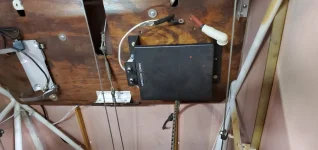
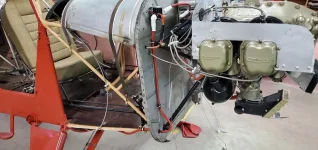
Battery. Master solenoid underneath.
20220126_140705.webp
Starter solenoid.
20220126_140723.webp

Chris
 
Last edited:
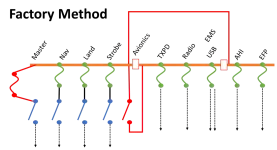
Discussed with my IA today. He said adding a bus would need a 337. OTOH if I have factory drawings that show cutting the bus and switching the gap, then modifying my aircraft to comply with that is is a logbook entry. So I guess that's where I'm going.
 
Revised schematic for my aircraft. Anyone see any issues? I am one bay short of having enough fuse holders for each device. Can I piggyback 2 on one fuse holder? Or should I do an inline fuse for the last device?

Avionics Master - factory method.webp
 
Chris - thanks. I value your opinion.

I debated about the master for the starter circuit - the J4 was already set up that way. A starter solenoid can fail, and you need a way to cut it off. But the Super Cub, and indeed all automobiles, skipped that step, so I opted to do the same.
The batteries have to be portable, so quick disconnects are desirable. Expensive for that kind of current, but still . . .

My main radio power is a dedicated battery, fused right there at the quick disconnect. The starter battery is my backup for the radio, as well as nav lights and strobe (which I rarely use any more).

I should have my personal Cub converted to this system by next week. Building the harness tonight. Photos soon.

Ed - sure glad I don't have to deal with IAs in general. To me a basic change in an electrical system would be generator to alternator, or maybe 12 to 24 volts. Adding a bus bar would be extremely low on my list of basic change. But I assume he will use 43-13 for approved data, instead of a full blown field approval? Then it is almost as easy as a log entry.

I note your post of five seconds ago - I put inline fuses in for non-essential stuff like GPS. I assume your USB is non-essential?
 
Ed - sure glad I don't have to deal with IAs in general.

I note your post of five seconds ago - I put inline fuses in for non-essential stuff like GPS. I assume your USB is non-essential?

It is what it is. I save a lot of money and hassle by having an IA who is willing to supervise me, check my work, and sign off. So I'm not going to argue with him about his interpretation of what he can sign off on.

Yes, USB would be the least essential, so I'll do an inline for that. Or, since I already have 2 fuse carriers in the space above, maybe I can talk my IA into leaving one in place.
 
Revised schematic for my aircraft. Anyone see any issues? I am one bay short of having enough fuse holders for each device. Can I piggyback 2 on one fuse holder? Or should I do an inline fuse for the last device?

View attachment 4723
It looks good to me the way you have it diagramed. Sure you can have more than one end device on a single fuse/CB as long as the combined draw is less than the amp rating of the fuse. Remember; the fuse protects the wire, not whats at the end of the wire.
One thing...USB chargers are notorious for creating static in the electrical system so if you DO double up on devices try to not have the USB box tied to your intercom or radio.
I actually try to have a dedicated hot line from the battery for USB chargers/outlets because (A) the battery is a great capacitor that sucks up static and (2) you can use the USB powered stuff (GPS) without the master being on.

Chris
 
Hey @Bartman, did you get your breakers from ACA? Any insight on cost to build a switch panel from scratch? I'm figuring 10 breakers and 5 switches at $20 each, so ballpark $300.
 
You could always start with a new panel.
View attachment 4735

Considering that option. Hence my question to Bart about breaker cost. From what I can see, it's probably a $500 project. Saw a FB post from Dale saying a switch panel and wire harness was $1500.😮
 
Hey @Bartman, did you get your breakers from ACA? Any insight on cost to build a switch panel from scratch? I'm figuring 10 breakers and 5 switches at $20 each, so ballpark $300.
cb's and switched breakers came from aircraft spruce, ignition and master switches came from ACA. i have been using one of their engineering drawings as a rough guide. made my own bus bars, have my own layout but it is done in the way they are doing it.
 
cb's and switched breakers came from aircraft spruce, ignition and master switches came from ACA. i have been using one of their engineering drawings as a rough guide. made my own bus bars, have my own layout but it is done in the way they are doing it.

Do you have a p/n for the CB's? Tyco or Klixon? Did you compare price to ACA?

Which circuits did you use a switched breaker for? Those suckers are expensive!
 
i misunderstood you Ed, i thought you were considering the full panel overhaul. the breakers are the Klixon 7274-2 series, the switched breakers are the Tyco W31 series. they are deep and bulky so be sure you have the room behind the panel for them. i didn't compare pricing with ACA.
 
Back
Top