Update, advice, and questions.
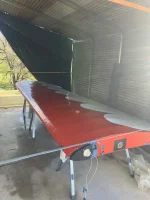
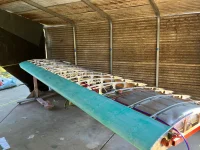
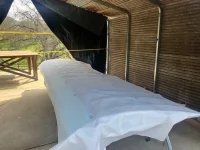
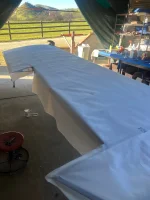
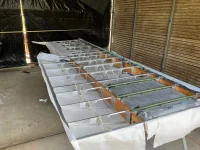
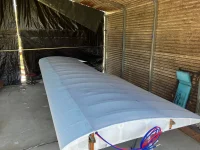
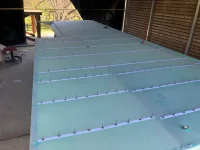
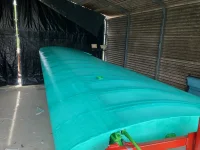
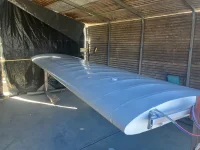
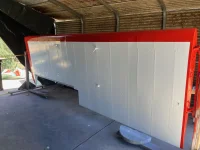
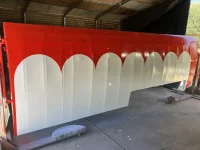
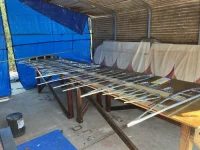
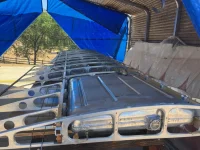
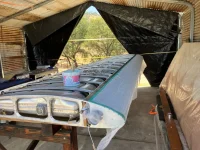
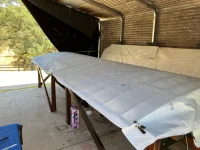
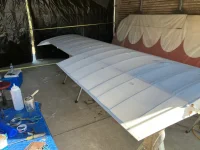
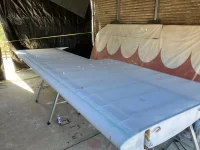
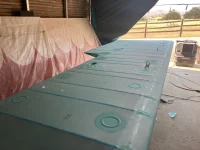
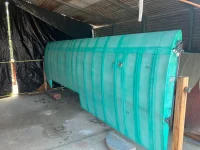
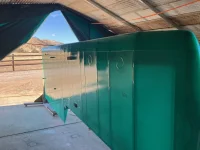
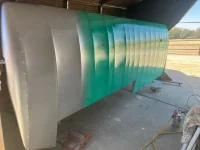
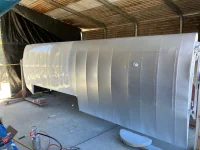
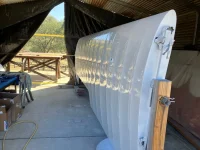
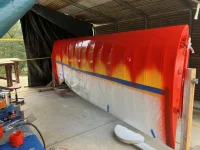
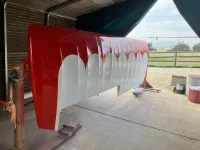
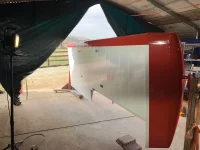
After finishing my left wing I switched gears to right. Turned into a recover instead of rejuvenation. Happy with spars and the overall build quality from the previous owner that rebuilt in 09.
I ran into a surface defect spraying dope on this wing that is not well written about called "alligator skin".
As a reminder this is a Ceconite job, utilizing Nitrate and Butyrate dope. I first saw this defect starting to develop when spraying transparent tan butyrate. The dope cures to a rough, textured, ugly finish. I say cured intentionally, because while shooting the dope and while observing the initial flash off period the surface is GLOSSED AND SMOOTH. However, during the cure period, the project turns on you and the defect forms.
The powerful solvents in dope when sprayed too heavy (excess dope on project) OR in too short of interval (project not fully cured from previous coat) OR having too high of solvent ratio in dope mix (not 50/50 dope to thinner) will lead to the dope to collect/pool, create miniature valleys, and eat at itself. These valleys, if not addressed, will only worsen with subsequent coats. The fix is not more coats to "fill the lows". The creation of the miniature valley's serve as reservoirs for the dope to pool, leading to further and
worse pooling if not addressed.
Essentially spraying too much, too fast, or too thinned can lead to a textured finish. Spraying more dope on that textured finish will not fix, fill or "melt it in" but rather worsen by deepening/sharpening the texture.
This is NOT to be confused with Pinholes. Pinholes are formed from an inadequate flash off period. Outer layer dries first, lower layers still off gassing, the gasses escape but at expense of breaking the surface tension of that cured outer layer. Most commonly seen over structure where all gases have to vent out in the same direction, compared to in open bays where those gases can escape both directions.
The simple fix to alligator skin was sanding all of the texture out, 320 wet, then continuing on.
I spoke with Consolidated Aircraft Coatings extensively about my defect throughout the whole process. Our first plan to fix it was sanding + spraying. Basically fill the lows by spraying light coats while knocking down the highs by sanding. Meeting in the middle to reestablish a smooth finish. I tried this for several coats and the wing got better and better, that being said the real results and great finish came only after sanding all of it completely out.
If you ever run into this defect you are time ahead to stay sanding until there is no texture at all before spraying your next coat. My attempt to sand + spray and "fix it throughout the silver process" only resulted in sanding all of those silver coats off that wing and starting over with a perfect surface.
The Citabria Parts Manual calls out for cheese cloth over the leading edge before base fabric. I found this rougher wider weaved cloth telegraphed through my dope job on left wing in several places. Hoped through the 16 coats of dope, and especially silver phase, that the telegraphing would get better....never really did. When I recovered the right wing I instead used a simple strip of Ceconite 102, glued around perimeter then bedded it to leading edge with Nitrate. Had 0 problems and the finish/smoothness of this leading edge is much better. I highly recommend this route over cheese cloth.
I have a bone to pick with the creases found in Bias tapes. They have been in every roll I have bought and are hard to get rid of. If you decide to persuade them with an iron you'll shrink the tape, if you decide to keep the crease they will translate through to finish. Sort of a lose lose.
For my ailerons I am going to experiment with Ceconite light straight tapes, pinked edge. I always seem to have a bubble or 2 when laying the medium weight tapes. Hoping the Lights lay down easier being a looser weave, similar to that of Bias, but without the Bias creases (and disgusting seams every 8 feet you must cut out).
Can someone walk me through washing out these wings post install? +1 degree angle of incidence is engineered into the wing root fittings on fuselage. Manual states adjusting rear spar length may be needed to "agree with the angle of incidence at the root", leading to 0 washout. My thought was aviation engineering favored the inboard section of wings stalling first, does 0 washout encourage that to happen? Has anyone adjusted washout after flying and having a heavy wing? When does my fixed rudder trim come in to play?
Thanks in advance everyone.