Does your plane have 36 gallon fuel capacity?i don't have the numbers in front of me but I think my empty weight is 1005 lbs.
You are using an out of date browser. It may not display this or other websites correctly.
You should upgrade or use an alternative browser.
You should upgrade or use an alternative browser.
7EC
- Thread starter Neoflyer
- Start date

No sir, 26 total
Don't know, mine is a '68.

B737jenkins
Well-known member
- Joined
- Jun 10, 2019
- Messages
- 54
My 7ECA is 1089 empty, for 561 lbs useful load.
ThanksMy 7ECA is 1089 empty, for 561 lbs useful load.
Bob Turner
Well-known member
- Joined
- Apr 4, 2018
- Messages
- 4,204
Looked up our old 1966 - 1012.0# empty. As I recall, that was weighed, with GPS comm, transponder, and very heavy automotive paint. It was within 5 lbs of factory weight. Still had the old heavy starter, generator, and battery.
Going lightweight on those three would take it below 1000#.
Bought it with low time engine for $25K. My neighbor got his license in it, then sold it for $19K on eBay. I guess he got his money's worth. It was a very nice trainer.
Going lightweight on those three would take it below 1000#.
Bought it with low time engine for $25K. My neighbor got his license in it, then sold it for $19K on eBay. I guess he got his money's worth. It was a very nice trainer.

aftCG
Well-known member
26 gallons for me too. Claims total and useable but one of those is incorrect obviously. I don't intend to find out which oneThat’s interesting. The Trade-Plane database says they have 36 gallon capacity so that must have changed from the earlier models. I wonder what year that happened?
Bob Turner
Well-known member
- Joined
- Apr 4, 2018
- Messages
- 4,204
1966 above had 26 gallons. At about 6/hr, more than enough.
B737jenkins
Well-known member
- Joined
- Jun 10, 2019
- Messages
- 54
Our 7ECA has 36 gallons of total fuel, but our club (there are 8 of us) agrees to keep it fueled to 20 gallons. We’ve only had it since July, but have put a little over 100 hours on the airplane, and our average flight is a little less than 1 hour. Pure fun, 1 hour at a time!

My 58 EC has dual 13 ga tanks (26 total) and has been converted to an O-235. I need to check the paperwork, but I seem to think the empty weight was around 900 pounds, with a gross of 1450. It always seems to fly "heavy" with two people on 18 gal. The plane has been on a diet, and I have a couple of boxes of obsolete instruments, wire, and venturis that have been removed I'm curious what my new empty weight will be. My plane is down for annual and this was part of that project. Hopefully we can get it on the scales to see how much it varies from the paper work.
The next project is a lightweight starter and alternator. My A&P suggested a new (composite) prop. Unfortunately the radio and ads b project has gone over budget and I'm missing flying the plane.
The next project is a lightweight starter and alternator. My A&P suggested a new (composite) prop. Unfortunately the radio and ads b project has gone over budget and I'm missing flying the plane.

HalfTonChamp
Well-known member
- Joined
- May 16, 2018
- Messages
- 52
My 1958 7EC is a converted 7FC, as are many. It weighs 1025, has a c-90 and is a fun and honest airplane. But it is not light. Add a passenger and it flies/handles well but is slow to climb. While I am trying to fix my oil pressure problem, I bought a Rans S-6 tricycle gear. It took 5 hours to fly it home and it burned less than 4gph. Champion burns 6. Fly what you like.My 58 EC has dual 13 ga tanks (26 total) and has been converted to an O-235. I need to check the paperwork, but I seem to think the empty weight was around 900 pounds, with a gross of 1450. It always seems to fly "heavy" with two people on 18 gal. The plane has been on a diet, and I have a couple of boxes of obsolete instruments, wire, and venturis that have been removed I'm curious what my new empty weight will be. My plane is down for annual and this was part of that project. Hopefully we can get it on the scales to see how much it varies from the paper work.
The next project is a lightweight starter and alternator. My A&P suggested a new (composite) prop. Unfortunately the radio and ads b project has gone over budget and I'm missing flying the plane.
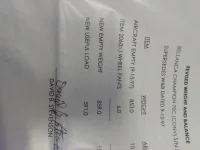
I remembered to take a picture of my w&b for my 0-235 powered 7EC. After reading some of the other numbers, I hope it's correct. I've been curious since I bought it a couple of years ago. It's been on a diet during this annual.
I just realized this w&b was for adding the wheel pants. They haven't been on it since before I bought the plane. They were handed to me in a box. I filled another box with things like venturis, g meter, and clock, among other things unnecessary on a Champ.
I just realized this w&b was for adding the wheel pants. They haven't been on it since before I bought the plane. They were handed to me in a box. I filled another box with things like venturis, g meter, and clock, among other things unnecessary on a Champ.
Attachments
Last edited:

BB57
Well-known member
- Joined
- Feb 20, 2020
- Messages
- 210
I’m aware of that. My question is does the factory, ACA, metal spar increase the empty weight of the aircraft therefore negating any or all of the 100# gross weight increase? I know the decision to go with the metal spar isn’t made to get the gross weight increase but it might be a factor.
I'm not sure this ever got answered....
The ACA metal wings with new larger struts increase the gross weight for the 7GCAA and 7KCAB from 1650 to 1750 pounds and from 1650 to 1800 pounds for the 7GCBC. Even if the spar adds 30 pounds, it's a significant net increase when you need to stay under the legal gross weight. How much weight they add is hard to say, as it's lost in the noise of weight differences in fabric and paint systems and other add on or weight loss efforts that usually occur at the same time. 30 pounds is probably a good ballpark figure, netting you about 70 pounds increased useful load. .
Practically speaking, my ACA metal spar winged 1967 7KCAB weighs 1215 pounds empty with 6.00x6 tires and wheel pants. Removing the wheel pants lowers the EW to 1201 pounds and adding 8.00x6 tires brings it back up to 1208 pounds. With a 1750 pound GW that leaves me 542 pounds useful load. With a pair of 200 pound people that leaves 142 pounds for fuel (23 gallons). At 5.5 gph at 100 mph and 2150 tpm, that gives me 3.6 hours and 360 statute miles with a 30 minute VFR reserve.
Even with a 200 pound pilot and a 240 pound passenger there's still room for 17 gallons - basically half fuel. Given that it'll burn the same 5.5 gallons per hour at 2150 rpm doing 100 mph, that's 2.6 hours and 260 statute miles with a 30 minute VFR reserve.
Alternatively with 400 and 440 pounds of people and full fuel it'll be 74 pounds and 114 pounds over gross respectively, but you'd never notice it on take off or climb. At the same 2150 rpm and 100 mph, that's 5.8 hours and 580 statute miles. However, 5.8 hours in a Citabria in anything other than dead calm, hands off flying conditions is pretty brutal.
Absent the GW increase with the ACA metal wings, in the 400 pounds of people scenario above you'd have just 72 pounds for fuel and 1.7 hours with a 30 minute reserve. Enough to fly around the patch very comfortably, but pretty limited for cross country.
Last edited:
BB57
Well-known member
- Joined
- Feb 20, 2020
- Messages
- 210
The 7 ECA was a 7EC with the Citabria treatment. That included the +5/-2 G acro certification (grandfathered in from the current standard), squared wing tips, rudder, and windows, with the Citabria windshield and cowling.I see. Champ vs. Citabria, I guess. Thanks
Compared to the 7EC, the GW went up, but so did the EW, so performance with the O-200 powered 7 ECA was somewhat uninspired. The 115 hp O-235 powered 7 ECA makes helps a lot from the power loading standpoint.
BB57
Well-known member
- Joined
- Feb 20, 2020
- Messages
- 210
I could never find out the difference between 7EC and 7ECA. That being said I had an O-200 powered Citabria that weighed 1045#. I don’t want the O-320 engine ones because they burn more fuel and I just want to putz around the area. Plus the big engine Citabrias have less useful load but need to carry more fuel thus less payload. I weigh 200# and want to carry another adult. I realize I will need to reduce fuel but would like to carry at least 25 gallons. I’m looking at one that weighs 1115# and was wondering if that’s about normal or might I find other 115 hp ones that weigh less?
I had similar thoughts - until I thoughts more about it.
The 7ECA wins on *legal* useful load. However, I fly out of a 1800' grass strip that tends to be very sandy and soft, with 80' trees at each end. On a hot humid day when the DA is up around 3000' (at a 50' field elevation) I'm very happy having a shorter take off roll and a solid 1000 fpm rate of climb at gross weight.
In a 7ECA I'd be looking at 200-300 ft longer take off rolls and a rate of climb around 600 fpm under those hot summer day conditions. I'd probably still make it over the trees, but it would be one of those keep it low and accelerate in ground effect before pulling up over the trees departures. I'd also be just over the trees with trees under me for almost half a mile in one departure direction. An engine failure in that first 30 seconds would put me in the trees, while the vulnerability in the 150 hp 7KCAB is just a few seconds.
Now...there is no free lunch, but the cost of of that lunch is still pretty cheap. the O-320 burns about 12.5 gph in climb at full power with a full rich mixture. On a standard 60 degree day it'll average about 1000 fpm from 0 to 4500 ft, so about 5.5 minutes at full power for take off and climb. That's about 1 .15 gallons of fuel. Once at altitude, I can throttle back to 2150 rpm and cruise at 100 mph burning about 5.3-5.4 gph leaned 100 degrees ROP for a 2 hour 200 mile leg that's about 12 gallons of fuel total.
In a 7ECA the full power full rich fuel burn is about 10 gph, but the average rate of climb will be around 600 fpm. The time at full power will be longer, and the resulting fuel burn will be about 1.25 gallons of fuel. At 100 mph the 7ECA will burn about 4.5 gph leaned 100 degrees ROP and a 2 hour 200 mile flight will have a total fuel burn of about 11.5 gallons.
Consequently the greater take off and climb performance only costs me a half gallon of fuel - when I fly the 7KCAB at the same airspeed as the lower powered 7ECA. You'll find that's true in pretty much any aircraft where different sized engines are installed in the same basic airframe (Comanche 180, 250, 260, 400, Cherokee 140, 160, 180, etc) - fly them at similar speeds and you'll get similar fuel burn.
The lower powered aircraft are slightly more efficient, but that efficiency increase is a lot smaller than you'd think. Unfortunately, that reality gets lost in performance numbers that use 75% cruise numbers, where more power equals more fuel burned. Best range is usually found in the 50-55% power settings, and on a draggy airframe like a Citabria it takes a lot of power and a lot of extra fuel to go significantly faster. It's usually not worth it. On the above mentioned 200 mile flight, 75% cruise in a 7 KCAB will get you there in about 1.5 hours at 130 mph, at about 11 gph with a total fuel burn of about 18 gallons (6 more gallons to save 30 minutes).
Bob Turner
Well-known member
- Joined
- Apr 4, 2018
- Messages
- 4,204
Man, I wish I had your leaning skills. My lowly 85s burn 4.5 per hour.
I did fly a Cub with a 160 hp O-320. 7 1/2 gph at 115 mph. It got modified somewhat, and lost 15 mph. Too bad.
I did fly a Cub with a 160 hp O-320. 7 1/2 gph at 115 mph. It got modified somewhat, and lost 15 mph. Too bad.
BB57
Well-known member
- Joined
- Feb 20, 2020
- Messages
- 210
Man, I wish I had your leaning skills. My lowly 85s burn 4.5 per hour.
I did fly a Cub with a 160 hp O-320. 7 1/2 gph at 115 mph. It got modified somewhat, and lost 15 mph. Too bad.
I had to invest in a JPI EDM-700. The "lean until it coughs and then enrich a bit" method I've used on Supercubs and Super Cruisers, 7GCBC and 7ECA Citabrias, and pretty much everything else with a fixed pitch prop didn't work well. The fuel injectors in it were close enough that it never coughed and ran rough, but instead just smoothly lost progressively lots more power.
However, once I installed the EDM-700, I discovered the injectors were not close enough matched to let it run smoothly lean of peak. It loses about 100-150 rpm depending on the day just getting to -5 degrees or -10 degrees peak and -25 degrees is way, way down the slope. So I run it 100 degrees ROP. At 2100 rpm I could probably run it at peak and not hurt anything.
BB57
Well-known member
- Joined
- Feb 20, 2020
- Messages
- 210
Man, I wish I had your leaning skills. My lowly 85s burn 4.5 per hour.
I did fly a Cub with a 160 hp O-320. 7 1/2 gph at 115 mph. It got modified somewhat, and lost 15 mph. Too bad.
I should add that from a brake specific fuel consumption perspective the results are consistent and expected.
Under ideal conditions, leaned for maximum efficiency most horizontally opposed engines will have a BSFC of between .43 and .50 pounds per horsepower per hour. Lower compression engines are a bit less efficient and will have a slightly higher BFSC than higher compression engines.
At 2150 rpm with my 7:1 compression IO-320E2A I'm at about 43% power, developing about 64.5 hp. That's roughly the same as a C-85 engine operating at 75% power (63.8 hp).
An 85 hp engine at 65% power will be producing 55.2 hp and a 4.5 gph fuel burn is comparable to my 150 hp numbers. An 85 hp engine at 65% power, developing 55.2 hp and burning 4.5 gph will have a BFSC of .49 pounds per horsepower per hour, while my 150 hp engine at 64.5 hp burning 5.4 gph is .50 gph.
----
Compression ratio also matters.
If you compare one of the 180 hp O-360s designed for 91/96 avgas with 8.5:1 compression cylinders or the 9:1 compression variants designed for 100 LL to one of the 7:1 O-320s, you'll actually find the O-360s have slightly better BFSC when operated at the same horsepower as the O-320s. If you drop down to the 7.2:1 compression 168 hp O-360s designed for 80/87 av gas you'll find they are about as efficient as the O-320 when operated at the same horsepower output.
Theoretically, a C-85 with 6.3:1 compression designed for 70 octane fuel should have a slightly higher BFSC than a 7:1 compression Lycoming designed for 80/87. However, I'm also running conservatively at 100 degrees ROP and burning probably .4 to .5 gph more fuel than necessary as a result.
So the low fuel burn in my O-320 has a lot less to do with mad leaning skills than it has to do with operating at lower power settings over all, in a high drag airframe where going faster takes a lot more power and burns a lot more fuel. The flight manual lists cruise rpm as low as 2000 rpm, and the green arc (mostly carb heat related) goes down to 1900 rpm, but my engine runs quite smooth in 2150 to 2200 rpm range, and it's running warm enough to keep the CHTs in the 340-350 degree F range.