Buying Used Parachutes

How do all these prop strikes occur in Citabrias and Decathlons? You have to get the nose pitched seriously - as in scary seriously - nose down to suffer a prop strike. Are they locking up the brakes and or trying to play STOL pilot with them? Or are they taxiing into fixed objects by not S-turning?
I was going to ask the same thing. I don't think there's any way I could get the tail of my plane off the ground at taxi speeds (even with locking the tires), and any attempt to get my tail in the air below about 35mph is ignored by the plane. I do make some very short landings and understand how that could ding a prop prop but that's the only situation I can see.
 
Who'd have thought orange on orange could look that good? I kinda like it!

Interesting conversations going on here but it always freaks me out to find out about an unknown-unknown like seat belts catching the rear stick and leaving the airplane uncontrollable. I was on my way to go flying and when I read that and gave my rear seat belts a sideways sneer before stepping in. And the back seat leaning forward to jam the stick? That is a serious WTF moment!

So glad to see these conversations happening here. We're all safer for it and it'll be here when the next person joins in, and the next, and the next.
 
Insidious.

The slower you are going, the more likely a prop strike if you jam on the brakes.

I had been taildragging for fifty years before I figured that out (not the hard way).

We started seeing experienced folks going on their nose on the taxiway! How could that be? One day I got a takeoff clearance, and started toward the hold line. Tower said "Cancel takeoff clearance; hold short . . ."
Wasn't going very fast - jammed on the brakes, tail came up a foot, released brakes, tail came down.

There it was - an inexpensive lesson. I caution all my students - no heavy braking at slow speeds! Still, over they go. Latest one was on a hot start a couple weeks ago. Airplane started to roll, pilot jammed on the brakes. Forty grand down the tubes. Experienced taildragger!
 
How do all these prop strikes occur in Citabrias and Decathlons? You have to get the nose pitched seriously - as in scary seriously - nose down to suffer a prop strike. Are they locking up the brakes and or trying to play STOL pilot with them? Or are they taxiing into fixed objects by not S-turning?

Of the two I know details of from talking to the pilots, one was a nose over from sudden application of brakes during taxi. The other was over- application of forward stick during a wheel landing.
 
Insidious.

The slower you are going, the more likely a prop strike if you jam on the brakes.

That makes sense. There's less inertia to keep the wheels turning at low speeds, so the brakes are more likely to lock.
 
It might have more to do with air flow over the horizontal stab. We can lock the brakes in Cubs at touchdown, but one needs to ease up a bit as things slow down.
 
I think a lot of factors can come into play. I do prefer the jack screw trim arrangement on the Cubs. It offers a lot more low speed elevator authority than the trim tab arrangement on a Citabria.

CG no doubt also comes into play, with an aft CG being a bit more resistant to a nose over than a forward CG.

Type of brake also makes a difference. Some of the older mechanical drum brakes can be pretty anemic. Single puck and in particular double puck disc brakes usually are a lot more effective. Regardless of the design it should not be "grabby".

Weight on the tires matters as well. I've watched videos from a strut mounted camera of myself landing on rough grass strips. I've noted the wheel briefly lock on occasion when the airplane hits a bump and bounces enough to take most of the weight off the wheel. However, with the brake lightly applied it spins right back up again and you don't even feel it in the plane.

Tires also slide a lot more on grass than they do on a paved runway and that also helps mitigate an over application of brake.

-----

It still surprises me is that so many people still have prop strikes caused by over application of brake. I learned to fly in a Supercub and lesson one was never use the brakes unless you have to, and lesson two was if you have to use them, only use the absolute minimum you need.

On a paved runway the need for brakes is not common, and then only very lightly applied.

------

You have to really work at it to get the nose far enough down to catch the prop on a wheel landing. Literally, the tailwheel needs to be about 7 or 8 ft in the air to catch the prop.

The exception here would be if you got a big bounce on an attempted wheel landing, didn't arrest the descent rate and slammed it down a second time hard enough to compress the gear, while applying a lot of forward stick thinking you were going to pin it on the ground. Do not try to pin it after a bounce. You need to have enough energy (speed or added power) to regain a very shallow descent angle AND a near zero rate of descent before you make another attempt. If you don't have that, you either convert it to a full stall landing, or go around.
 
I'm starting to think this topic could be split off because prop strike could be useful information to future readers.

I shudder to think of a 7-8' bounce followed by an attempt to "stick the mains". In my plane any attempt to stick a wheel landing from even 6" will produce that first 7' bounce.

There is absolutely no "shove the stick forward" during wheel landings in my aircraft. Assuming I'm trimmed for the approach I flare enough to arrest the descent rate (as low as possible), then release that back pressure when the tires touch
 
The prop strikes I am familiar with happened on Super Decathlons, so the extra weight on the nose may have been a factor. The extra couple inches of prop diameter might also be a factor.

The story I heard on the pictures shared above was the pilot did his runup, started to taxi, and then suddenly changed his mind and stopped after only a few feet of movement. He probably goosed the throttle to get rolling and then backed off. So at the point where he slammed on the brake, he may have had had no airflow across the elevator from prop wash.

Unfortunately the instinctive reaction to stand harder on the brakes would be the exact wrong thing to do. The correct response would be to release the brakes and apply full back stick and partial power to get some airflow over the elevator. Assuming of course that the path in front of you is clear for long enough to stop. Wouldn't want to do that while taxing into your hangar.

The prop strike that happened to the Decathlon I was a part owner of happened during wheel landing training with a new pilot trying to get his TW endorsement. He kept bouncing, got frustrated, tried to plant it hard, and spread the gear enough to make contact with the runway.
 
I'm starting to think this topic could be split off because prop strike could be useful information to future readers.

I shudder to think of a 7-8' bounce followed by an attempt to "stick the mains". In my plane any attempt to stick a wheel landing from even 6" will produce that first 7' bounce.

There is absolutely no "shove the stick forward" during wheel landings in my aircraft. Assuming I'm trimmed for the approach I flare enough to arrest the descent rate (as low as possible), then release that back pressure when the tires touch

The 7' to 8' reference isn't the height of the bounce. It's the height the tail wheel would need to be with the mains on the ground before you'd get a prop strike. That's a very negative angle of incidence.

The problem with trying to salvage a wheel landing from a bounce, particularly anything after the first bounce, is that the pilot can get out of sync with the aircraft and the resulting PIO can drive the plane into the ground hard and at a very negative angle. That can easily cause a prop strike. Big Ed's description above is a good example of that.

In terms of stick movement it's semantics. Releasing back pressure is still forward stick movement. But regardless what you call it, too much is too much. You see the same thing in spin recoveries in a CItabria, where easing off on the back pressure to a neutral position will break the stall, yet some nervous pilots will shove the stick well forward and end up nose down to almost inverted in their eagerness get the wing flying again.
 
Ed has it.


The story I heard on the pictures shared above was the pilot did his runup, started to taxi, and then suddenly changed his mind and stopped after only a few feet of movement. He probably goosed the throttle to get rolling and then backed off. So at the point where he slammed on the brake, he may have had had no airflow across the elevator from prop wash.


This is insidious. Sure, you can have a heavy tail - but it is the impulse that gets you. You have a center of mass above the main mounts - slightly behind, but above. You stop the mains, and the mass just keeps going forward. It happens really fast, and the only cure is to instantly get off the brakes.

Teach this to your students. It happens to some really good aviators. I know of three, all with thousands of hours. Almost happened to me twice, but my reflex is to get off the brakes the minute the tail leaves the ground. That comes from all the 150 foot stops we practice - often enough braking to screech the tires.
 
Looking hard for a parachute. I hope to compete in the spring, so I would like to start practicing soon.

As others have said, it's hard to find good used chutes. I'm chasing a couple of ads, but everything so far is over 20 years old.

At this point I would probably just bite the bullet and get a new one. BUT ... turns out the waiting list for a new chute is 3 to 4 months!!
 
Would rather have my own. I'm pretty busy with my business. Want to drive up, chute up, crank it up, and fly. Plus I have not seen any other acro aircraft at my home airfield.

One good thing about a new chute: they have pretty good resale value. I could buy one, fly for 5 years, and sell for ~75% of cost.

Talking to Greg Koontz about a pair of Nationals. I suspect they are too old, but we will see. There are a couple other ads on Barnstormers I am chasing down, and I put a WTB on the Acro list. Something will pop up eventually. If I decide to go with a back chute, it looks like Gulf Coast Aviation has new Strongs for about 15% under MSRP. I am guessing they carry some in stock, but not sure.
 
Last edited:
Bunch of prospects popped up today. Turns out you gotta shake the tree a bit with some WTB posts. Choices:
  1. New softie seatpack with Decathlon seat dimensions.
  2. 3 year old softie seatpack with standard seat dimensions.
  3. 15 year old backpack.
  4. A crapload of >20 year old backpacks for $500 that people are selling because they can't get them packed.
At this point I am leaning towards #1. I figure I will probably never find one of those on the used market.
 
Last edited:
Ed, maybe you've done this already, maybe not, but before you buy a backpack style chute, wear one and sit in the plane. My Citabria doesn't have adjustable seats and the one time I had to borrow a chute it was a backpack. Being that I was already used to my seat pack, the backpack pushed me uncomfortably forward. Size and body type have a lot to do with it but I would recommend a seat type chute without testing it out before a backpack style. YMMV. Good luck and looking forward to hearing how practice flights go for you.
 
I'm generally in agreement with Bart, as it's the quickest easiest way to get up to speed. But...there are potential downsides.

Silver Parachutes usually has parachutes in stock. If he has to order one, or you want custom colors, etc, he'll send you a demo to use until your arrives.

He also has demo chutes that he'll sell at a discount.

He'll also sell you a chute he has in stock and allow you to return it if it doesn't work in your plane. Now...that's a try it and return it right away, not use it for a couple weeks and return it offer, but it still limits your risk to the cost of shipping the chute back.

----

Allen Silver will strongly suggest you to buy a back type parachute if you fly a Citabria or Decathlon. That's based on his 35 plus years of experience selling parachutes and talking with people who have actually had to exit a CItabria or Decathlon. Based on that feedback Allen states a seat pack is harder to get both in and out of the airplane than is the case with a back style chute.

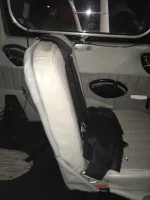
However, as bart indicates, without adjustable seats you will almost certainly have to remove the back pad on the seat to have enough room to get full aft stick. In my case, I separated the seat pad from the envelope that slips over the seat frame, and sewed a new back on the seat pad cover. . I then also sewed a new envelope to attach to the seat frame. The seat back now attaches to the envelope over the seat frame with two strips of velcro.

I'm still maybe an inch farther forward than before, as while the seat pad and parachute are about the same thickness, the pad compresses and the parachute does not. But it's still comfortable and gives me full aft stick travel.

I leave the bottom cushion in place and in it's normal forward position, so that the bottom of the back pack on the parachute can slide down behind it. That keeps it from riding up on your back.
126936076_1798830286942538_5166194670103597162_n.webp

I have two chutes, one with quick ejectors and one with B-12 snaps. I use the one with quick ejectors and the chute with the B-12 snaps for student or passenger use. It keeps them from messing with the quick ejectors, and it's still much faster to put on or off than thread through.***

I didn't see a need for an aerobatic harness, especially with stock travel being an issue, and with decently padded lap belts the B-12s and quick ejectors are comfortable.

*** I use a thread thru on the chest strap, but it's rigged so that it loops back through the fitting so that it can be quickly released with a single pull. It's a good idea to take the chute off like you would if you had used it and were being dragged in the wind. In short, undo the chest strap first, so that when you release the leg straps you don't get drug my the chin.
 
My suggestion is to get a wedge shaped backpack shute. The seats are fully upright, and the straight chutes hurt my lower back pretty quick into the flight. The wedge chutes are much more comfortable. I've tried the seat chutes - BB57 is right - I could hardly climb in / out of the plane. Softie makes a wedge chute, but I bought National
If you buy from High Time Sky Diving in Harleysville, PA - you'll get a discount since he's the one that stocks and packs ALL national chutes in the US, regardless of whom you order it from. Lot of great used chutes out there - but after hearing stories of used chutes that were not stored properly, mistreated, etc., I decided to buy new.
 
Also, for the seat backs - I bought a pair of 18" x 18" synthetic leather decorative pillow cases off Amazon for $15, cut off the bottoms with a scissor, and voila, they fit perfectly on the seat back frame.
 
Back
Top