hahaha, sorry for laughing. I saw that coming though. I hate ceconite, hard to repair. I would at this point remove the tail feathers, strip the vertical. remove wing route fairings. tape off everything, and spray. replace or patch any tapes as required, and start building up the dope and nitrate. I have seen a few planes that they had used paint rollers to apply all the layers. It actually looked pretty good from 10 ft away. Good luck to you Sir!
You are using an out of date browser. It may not display this or other websites correctly.
You should upgrade or use an alternative browser.
You should upgrade or use an alternative browser.
Ceconite rejuvenation
- Thread starter Big Ed
- Start date

Bruce
Well-known member
I had feared this might be where you ended up. Someone else on this sight will have more knowledge than me, but when I started my recover project all the suppliers told me “no mixing finish systems” but by looking at these pictures the bulkheads appear to be bowed at least and more than likely rotted at the lower section. This is a good time to do a punch test on airframe at the tail wheel structure for any corrosion. I think ur at a decision of weather to recover or not. Otherwise this might be a lot of effort, money, and time for short term gain.
Best of luck
Best of luck

I have read it is theoretically possible to replace a bulkhead with the cover on. The forward two bulkheads nearest the battery are indeed bowed. I can see the rest from the battery compartment and they are ok.
The way I see it, I am only out a couple hundred bucks of dope and a few weekends of spraying If I recoat.
The way I see it, I am only out a couple hundred bucks of dope and a few weekends of spraying If I recoat.
After conferring with my friend runs the airport (and is an IA), I feel better. He restores old warbirds, and has covering experience.
Big decision is to leave the tail surfaces alone. He says removing the elevator and h-stab adds a month to the down time, because of the paperwork. This baffles me, as the mechanical work appears to be a few hours at most ... but he's the IA.
We are going to try to replace the 2 formers/bulkheads aft of the battery box. They are both in really bad shape. Mixed verdict so far on how difficult this will be.
One bad problem area is the fabric at the lower rear corners of the rear windows. Any tips on that? Also, the lower and rear rubber seals on the rear windows have long since rotted.
Big decision is to leave the tail surfaces alone. He says removing the elevator and h-stab adds a month to the down time, because of the paperwork. This baffles me, as the mechanical work appears to be a few hours at most ... but he's the IA.
We are going to try to replace the 2 formers/bulkheads aft of the battery box. They are both in really bad shape. Mixed verdict so far on how difficult this will be.
One bad problem area is the fabric at the lower rear corners of the rear windows. Any tips on that? Also, the lower and rear rubber seals on the rear windows have long since rotted.

Ed,
I saw your conversation on FB. I'm thinking, if you don't want to get into the whole problem of restoring everything underneath, get that mother effing thing repainted as soon as possible and get back to flying the crap out of it. If your IA says the fabric is ok, just build it up with Stewart System products and get back to flying it. Stewart is certified for repairs.
if the horizontal stabs are ok, leave them alone. don't even look at them if you can help it and just get the fuselage all done. If your IA is ok with the one blinky looking former, don't even touch it or try to double it enough to put some strength back into it.
Once the fabric comes off you're going to want to restore it.
Regarding Stewart Systems, the owner Andy is extremely approachable. Call him and tell him where you're at. I'm going to bet he'll say his products will go right over what you've got.
Just my opinion.
I saw your conversation on FB. I'm thinking, if you don't want to get into the whole problem of restoring everything underneath, get that mother effing thing repainted as soon as possible and get back to flying the crap out of it. If your IA says the fabric is ok, just build it up with Stewart System products and get back to flying it. Stewart is certified for repairs.
if the horizontal stabs are ok, leave them alone. don't even look at them if you can help it and just get the fuselage all done. If your IA is ok with the one blinky looking former, don't even touch it or try to double it enough to put some strength back into it.
Once the fabric comes off you're going to want to restore it.
Regarding Stewart Systems, the owner Andy is extremely approachable. Call him and tell him where you're at. I'm going to bet he'll say his products will go right over what you've got.
Just my opinion.
You got this Ed!
I agree, you got this Ed!
I wonder if you can cut off the bottoms of the formers, splice replacements in and use plywood doublers to make the splice secure above the tabs? That way you wouldn't be disturbing the joints with the stringers and would lessen the chance you'll break the tabs that the formers attach to.
Bob Turner
Well-known member
- Joined
- Apr 4, 2018
- Messages
- 4,237
I think once you get to bare fabric everywhere you can tape and spray just like a new cover. I have never even attempted such a project, but it should work, assuming you are down to nitrate.
This is just an opinion, but once you get to this point it is probably easier to recover. I can do a wing through silver in about four days, and a fuselage should go quicker than that. The assembly/disassembly takes lots longer.
This is also an opinion - with minor cracks in an old Bellanca fuselage, consider using Stewart’s glue and just putting tape over the cracks. I will get a photo of one we did almost a decade ago. It is starting to show its age, but it has been outside the whole time. I saved a Citabria wing the same way - somebody had sprayed auto catalyzed enamel over the entire aircraft, and all the ribstitch rivets had cracks. Two days later all ribs were covered with new tapes and Eko-Fill. Again outside storage. Sun and rain did not affect the Eko-Fill. Six months later I quickly hit the tapes with white Butyrate to sort of match the wing. Two years later the aircraft was sold.
I tried to post this about six hours ago - probably out of sequence now. I will get photos tomorrow.
This is just an opinion, but once you get to this point it is probably easier to recover. I can do a wing through silver in about four days, and a fuselage should go quicker than that. The assembly/disassembly takes lots longer.
This is also an opinion - with minor cracks in an old Bellanca fuselage, consider using Stewart’s glue and just putting tape over the cracks. I will get a photo of one we did almost a decade ago. It is starting to show its age, but it has been outside the whole time. I saved a Citabria wing the same way - somebody had sprayed auto catalyzed enamel over the entire aircraft, and all the ribstitch rivets had cracks. Two days later all ribs were covered with new tapes and Eko-Fill. Again outside storage. Sun and rain did not affect the Eko-Fill. Six months later I quickly hit the tapes with white Butyrate to sort of match the wing. Two years later the aircraft was sold.
I tried to post this about six hours ago - probably out of sequence now. I will get photos tomorrow.
I wonder if you can cut off the bottoms of the formers, splice replacements in and use plywood doublers to make the splice secure above the tabs? That way you wouldn't be disturbing the joints with the stringers and would lessen the chance you'll break the tabs that the formers attach to.
I looked at doubling the formers, but they are wicked warped. I would have to clamp wood on both sides and compress it pretty hard.
Bob Turner
Well-known member
- Joined
- Apr 4, 2018
- Messages
- 4,237
Also - to answer your post about two months down for tail feathers - I did a 7KCAB in a weekend. I think the tail feathers are the same on a Decathlon. That included disassembly and assembly, but no "sunburst".
Edit - it was a four day weekend!
Edit - it was a four day weekend!
that doesn't make sense to me either. I had the tail off my Citabria when I painted over the old paint. the tail all got painted too. we threw it all back together and the IA signed it off. 337 for the paint maybe? ask him if it would apply if you don't repaint the tail feathers.
Bob Turner
Well-known member
- Joined
- Apr 4, 2018
- Messages
- 4,237
No - only the cover is a major repair. Re-taping and paint is not. Disassembly/reassembly can be done and signed by an A&P.
IAs learn as they grow - we are required to either do certain formal things or attend eight hours/year of "schoolhousing."
Took me a couple years to fully grasp this 337 stuff.
It is easy, and I would happily post something if you want.
IAs learn as they grow - we are required to either do certain formal things or attend eight hours/year of "schoolhousing."
Took me a couple years to fully grasp this 337 stuff.
It is easy, and I would happily post something if you want.
Bruce
Well-known member
The 43.13 gives guidelines on being a major repair or minor. Best of my memory (feeble at best) if you go more than 2 ribs on fabric or control surface it becomes a major repair and then requires 337. But repaint shouldn’t fall into that.
As for using the Stewart’s system, my experience has been great my suggestion is when you start painting make sure anything you don’t want overspray on is covered or far away. Second don’t rush the painting and it turns out looking great.
Best of luck on what you do and keep updates coming.
As for using the Stewart’s system, my experience has been great my suggestion is when you start painting make sure anything you don’t want overspray on is covered or far away. Second don’t rush the painting and it turns out looking great.
Best of luck on what you do and keep updates coming.
It's not the paint and cover he claims is the issue. It is specifically the disassembly and reassembly of the horizontal tail surfaces.
At this point it is a non-issue, as I have decided not to strip the V-stab. I am going to stop the refinishing at the point where I have currently stripped to, roughly plumb with the leading edge of the H-stab. Per picture below. Next fall when the temperature is reasonable again, I will consider removing and recovering the tail surfaces and refinishing the tail cone and V-stab.
I have already bought the dope products, so I think I am committed to that system. Plus I am leaving the dope on the tail and belly. Am concerned that if I used Stewarts for the top and sides, I would create a mixed coating Frankenstein monster for the future.
Starting to think I will probably recover when I get my engine rebuild in the next year or two. Based on that, just want to get it back flying again at this point. Simplest and most direct path is spray dope back on.
One thing I will say about Ceconite: the new Super Seam cement is some crazy strong stuff. It will definitely hold down lifting tapes.
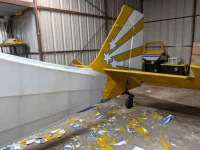
At this point it is a non-issue, as I have decided not to strip the V-stab. I am going to stop the refinishing at the point where I have currently stripped to, roughly plumb with the leading edge of the H-stab. Per picture below. Next fall when the temperature is reasonable again, I will consider removing and recovering the tail surfaces and refinishing the tail cone and V-stab.
I have already bought the dope products, so I think I am committed to that system. Plus I am leaving the dope on the tail and belly. Am concerned that if I used Stewarts for the top and sides, I would create a mixed coating Frankenstein monster for the future.
Starting to think I will probably recover when I get my engine rebuild in the next year or two. Based on that, just want to get it back flying again at this point. Simplest and most direct path is spray dope back on.
One thing I will say about Ceconite: the new Super Seam cement is some crazy strong stuff. It will definitely hold down lifting tapes.
I spoke to Dale Gauger. He says he has done bulkheads with the cover on. He said it was a tight fit and frustrating ("you may cuss a little bit"), but doable.
A bit irked that the parts are not available for the #2 until next week. Might consider owner fabricated. I have a bandsaw.
A bit irked that the parts are not available for the #2 until next week. Might consider owner fabricated. I have a bandsaw.
Bob Turner
Well-known member
- Joined
- Apr 4, 2018
- Messages
- 4,237
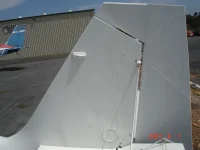
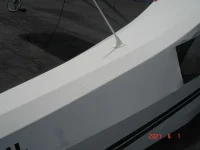
I looked back in my records - we did this one in 2013. It has been outside since. The aircraft is a 1979, with original fuselage fabric. When purchased in 2012, it had black tape covering all the fuselage stringers.
Tape was like electrician's tape, except that it actually stuck - sort of.
Under the tape were cracks like Ed's all along each stringer. We removed the tape, scuffed up the dope, and using Stewarts glue, attached the pinked edge tapes you see. Then we did Eko-Fill, and wet-sanded. A final coat of insignia white Butyrate was shot, just to avoid the ugliness.
After a year or so, the owner took it to a local shop, and they sanded and shot Randthane over everything we did. The aircraft has been parked outside since 2012, and these photos were taken today.
Note that there are now cracks appearing. None of these cracks are in areas we taped over. Herewith: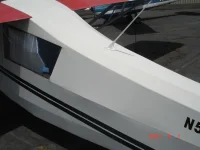
Tape was like electrician's tape, except that it actually stuck - sort of.
Under the tape were cracks like Ed's all along each stringer. We removed the tape, scuffed up the dope, and using Stewarts glue, attached the pinked edge tapes you see. Then we did Eko-Fill, and wet-sanded. A final coat of insignia white Butyrate was shot, just to avoid the ugliness.
After a year or so, the owner took it to a local shop, and they sanded and shot Randthane over everything we did. The aircraft has been parked outside since 2012, and these photos were taken today.
Note that there are now cracks appearing. None of these cracks are in areas we taped over. Herewith:
A smart man knows when to stop digging a hole and shift his focus to getting out of that hole.
I am not a smart man.
Today I opened up the boot cowl and removed the rear windows.
Going to break off this thread for a while and open a thread about recover decision.
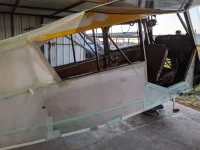
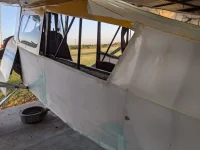
I am not a smart man.
Today I opened up the boot cowl and removed the rear windows.
Going to break off this thread for a while and open a thread about recover decision.
On second thought, I'll keep the discussion in this project thread.
Starting to reconsider a recover, but NOT a full restoration. Eg do the minimum necessary to inspect the frame, fix any problems, and put new fabric on the fuselage ONLY.
I got into the tail today, cleaned the frame with mineral spirits, and gave it a good inspection. There are a few small areas of surface corrosion on the lower longerons just aft of the battery area. The rest of the frame looks very good.
I know the school solution is to remove everything from the frame, blast it bare, repaint, and put everything back together. But that seems like overkill in my case. I really just need to replace the formers, fix any corrosion along the bottom of the frame, and give everything else a good IRAN.
So here is my question: could I do a fuselage recover without completely disassembling the aircraft? Obviously I would need to pull off the wings and tail surfaces, but could I leave on the engine, instruments, electrical, etc? Just cut the fabric off the fuselage, get a look at the bottom of the frame and fix as needed, then glue on a new envelope, tape and shrink, then hire someone to paint.
If I did it that way, how long would it take to get from where I am right now back to the same point, but with fresh fabric and a repaired frame? I'm having a hard time understanding why it would take that long.
The guy who runs the airfield is an IA. He has 2 college kids who are A&Ps working for him as interns while they build time for their IA. If I cut a deal with him for all 4 of us to dogpile the work, how fast could we get it done?
Starting to reconsider a recover, but NOT a full restoration. Eg do the minimum necessary to inspect the frame, fix any problems, and put new fabric on the fuselage ONLY.
I got into the tail today, cleaned the frame with mineral spirits, and gave it a good inspection. There are a few small areas of surface corrosion on the lower longerons just aft of the battery area. The rest of the frame looks very good.
I know the school solution is to remove everything from the frame, blast it bare, repaint, and put everything back together. But that seems like overkill in my case. I really just need to replace the formers, fix any corrosion along the bottom of the frame, and give everything else a good IRAN.
So here is my question: could I do a fuselage recover without completely disassembling the aircraft? Obviously I would need to pull off the wings and tail surfaces, but could I leave on the engine, instruments, electrical, etc? Just cut the fabric off the fuselage, get a look at the bottom of the frame and fix as needed, then glue on a new envelope, tape and shrink, then hire someone to paint.
If I did it that way, how long would it take to get from where I am right now back to the same point, but with fresh fabric and a repaired frame? I'm having a hard time understanding why it would take that long.
The guy who runs the airfield is an IA. He has 2 college kids who are A&Ps working for him as interns while they build time for their IA. If I cut a deal with him for all 4 of us to dogpile the work, how fast could we get it done?