Fuel quantity indication, air vs. ground

Got to thinking about the concept of non-linear measurement. Was an interesting intellectual exercise. Here is my back of the envelope analysis.

Or maybe it is a submarine.

View attachment 3862

that explains it pretty well, i never really thought about the geometry of it but that makes it really clear. i can't unsee the submarine now. :(
 
Knowing how much fuel I really had might mess up my weight and balance calculations. Having more fuel than you planned for is likely a good thing except when engaged in maximum performance takeoffs and snap-rolls.
 
Knowing how much fuel I really had might mess up my weight and balance calculations. Having more fuel than you planned for is likely a good thing except when engaged in maximum performance takeoffs and snap-rolls.

I never fly XC without full tanks, so dipstick accuracy is a non-issue. For acro I keep between 10 and 30, adding 20 from the pump each time I get to 10. So as long as my stick is accurate to within +/-5 gallons, that is sufficient for me.

I am slowly succumbing to the siren song of a fuel computer though.
 
You can make one yourself. Get a couple of paint stirring sticks and a sharpie. As a quick and dirty solution, fill your tanks to the bottom of the neck, dip the stick and mark as full, then divide the length below into 1/4 increments. Bob has probably done this a million times, so I bet he knows the best way to find more accurate markings.
Any of the methods of creating a calibrated dip stick present a problem. I tried it the 2 gallon at a time method. When I finished the totals to fill the tanks were wildly different. Setting aside something might have happened to one tank my conclusion was while filling one side fuel ported to the other. Without being able to isolate the two tanks I don’t think either method will be successful. My understanding is the fuel shutoff valve is after the crossover hose so that doesn’t help. Am I right? Is there any convenient was to isolate the two tanks?

Other than that I could possibly find a fueling truck with two hoses and have two people add a certain number at a time and mark the sticks quickly. Problem is I think there is only one gauge on a truck so simultaneously putting the same amount in each tank is a problem. Two trucks maybe? Not likely. Back to the earlier commenter who noted this is getting way too complicated.
 
Any of the methods of creating a calibrated dip stick present a problem. I tried it the 2 gallon at a time method. When I finished the totals to fill the tanks were wildly different. Setting aside something might have happened to one tank my conclusion was while filling one side fuel ported to the other. Without being able to isolate the two tanks I don’t think either method will be successful. My understanding is the fuel shutoff valve is after the crossover hose so that doesn’t help. Am I right? Is there any convenient was to isolate the two tanks?

Other than that I could possibly find a fueling truck with two hoses and have two people add a certain number at a time and mark the sticks quickly. Problem is I think there is only one gauge on a truck so simultaneously putting the same amount in each tank is a problem. Two trucks maybe? Not likely. Back to the earlier commenter who noted this is getting way too complicated.

Add 2 to each tank, and then give it time to cross level. Dip both sides to see if equal.
 
I am slowly succumbing to the siren song of a fuel computer though.
Go the all-in-one engine monitor route and fuel computing is built in via a manual fuel entry and a fuel flow sensor. They can display fuel levels too if we had tanks with electric level gauges. Bonus is you can yank all of the analog engine and electrical gauges.
 
Go the all-in-one engine monitor route and fuel computing is built in via a manual fuel entry and a fuel flow sensor. They can display fuel levels too if we had tanks with electric level gauges. Bonus is you can yank all of the analog engine and electrical gauges.
I've been looking hard at an EMS, but do not want to spring for that kind of money. IMO it is overkill to put a $5K monitor in a $50K airplane. If I was doing a full resto and starting from scratch, it would be a no brainer. But most of my gauges are fine, so in my case I can fill the gaps in capability for less cost. I can get a fuel computer with flow transducer for $500, and a 4 cylinder EGT/CHT for $1500. At that point I am out of gauge holes, but also out of need for holes
 
i totally get that but $2000 is a lot of money to add a small portion of the capability of a monitor. I agree though, they're too expensive for what they are, even the small Garmin one is the same $$$ as the larger JPI, it's kind of a rip off.
 
I have spent a very lot of time aloft with a compass and a watch. I knew for a fact that 2 1/2 hours aloft and I would need to be on the ground. In 60 years and 22,000 hours, I have never run out of fuel or declared a low fuel emergency.

I flew jets before all this fancy stuff - most sophisticated was the early A-320. I was never uncomfortable with adding the number of gallons uploaded to the gauge indications.

The stock Decathlon, when full, has a very safe range of three hours. That is a very long time to sit in a tandem aircraft.

Yes, dipsticks are an approximation - but I dip before every flight unless the tanks are full.
 
My drip stick works like a champ. Gauges match the stick. Accurate too. Thanks to whomever that gave me the calibration marks. I rarely fly it for more than an hour though. My butt gets too tired!!
 
I'm the opposite. Once I invest the effort to climb, I want to stay up there. I plan for 3 hours, but have been gradually experimenting with going longer at lower power settings. I always top of tanks and compare planned to actual burn. Based on my data, up to 3.5 is doable with a 30 min reserve plus fudge factor.
 
b727plumber ,
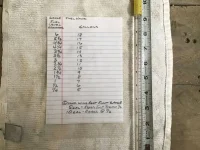
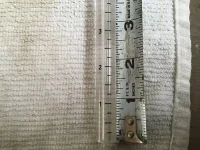
I will get a few picts of the story card and fuel gauge to you in the next day or two .
If I cant figgure out how to post picts here , I can text/email them to you .
In the meantime , you might want to do a web search for ehe “Fuel Hawk UNIVERSAL 11” fuel gauge “ to give an idea about what it is .
Gillie
 
Last edited:
I went looking for the "Fuel Hawk." I have used them, but a marked wood stick is better.

Reason I went looking - we have a Taylorcraft going together and need something other than a Pyrolin tube for fuel gauges. Thinking a slightly shorter Super Cub tube.
 
My Fuel Hawk is the 16”Universal , avail at Spruce , pn 00949 , $17.95 . You might get one off fleabay for 5 bucks .
I will attempt to post the pictures of my story card and gauge here , now (sure wish one of my grandkids was here ).
Im electro tech retarded so if they dont show up , if one of you gents shoots me a email or text , I’ll get them to you and you could post them if so inclined .
(406) 331-0058
[email protected]
FB1164BE-72F5-4690-9DB6-217B4CEFE8F7.jpegFB1164BE-72F5-4690-9DB6-217B4CEFE8F7.jpeg52B086FC-C144-4D98-AC9A-4363E3DA4544.jpeg52B086FC-C144-4D98-AC9A-4363E3DA4544.jpeg5DDC1E56-2D43-4069-ACDE-FFAEFE9336D5.jpeg5DDC1E56-2D43-4069-ACDE-FFAEFE9336D5.jpegFB1164BE-72F5-4690-9DB6-217B4CEFE8F7.jpeg52B086FC-C144-4D98-AC9A-4363E3DA4544.jpeg5DDC1E56-2D43-4069-ACDE-FFAEFE9336D5.jpeg
 
Looks like they posted but if the large size is taking up too much ”space “ , please advise and after any interested persons get the info they need I will attempt to delete them .
Hope this helps .
FYI , when I dip the gauge, I insert it by sliding it down to the bottom of the tank by resting it on the rear of the filler neck .
 
My understanding is the fuel shutoff valve is after the crossover hose so that doesn’t help. Am I right? Is there any convenient was to isolate the two tanks?

there are both front and rear crossovers, the rear feeds come together in a manifold behind the cargo area, the front feeds from each tank come together in a second manifold just before the fuel valve.

Each "manifold" is an aluminum block with multiple ports for fuel lines in and one out plus the drain in the rear.
 
Back
Top