8KCAB Gear Strut Failure

Update time! The insurance company totaled the plane. Not surprising given this was the list of expenses they had to contend with:
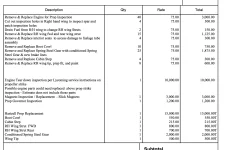
1588353507089.webp

It totals about $43k if you don't care to do the math.

I have heard all the arguments for letting the plane be scrapped, but either I'm sentimental or stupid or both. I really don't want to be the reason an affordable vintage aircraft stops existing on this earth. My plan is to buy it from the insurance company and have the repair work done.

I will end up getting about $40k from the insurance company. I'll spend $24k to have the engine overhauled at Zephyr (it was at 1570 SMOH on a 1600 TBO), spend $17k for the MT composite prop and field approval, $9k for the new aluminum gear and install, and be in the hole about $20k. Fortunately I will get a new engine out of it, which should add maybe $10k to the value of the airplane.

The shop where the accident occurred isn't super excited about the welding work to do the gear conversion, so I'm looking into options to get the aircraft shipped to the AC factory shop. That will cost a few thousand as well unfortunately.

One option the factory mentioned is they could also just do a conversion to the 180 HP engine. I don't think it's necessary, but I would be curious what people think about this or any of the other ideas I've mentioned.

I've also had a few conversations with the local FSDO. They've been super friendly and helpful. I am very glad that I and the plane were legal! If you've been putting off your transponder check or BFR, do it, you never know what might happen.

I did get one quote for having a fracture analysis done on the strut: $2600. It seems a little steep just to satisfy my curiosity. I'm hoping the factory will look at it.
 
This is where you need to make a decision as to how committed you are to bringing this plane back to life. Personally I 100% applaud that decision and wish people would quit purchasing these planes to run them out and then dump them. They need good caretakers but that takes money. So you will be doing the flying community a huge benefit keeping her flying-but it is going to cost a lot more than you are estimating. I hope you have the resources and go for it.
 
Regarding the gear related welding, it isn't for the mounting of the gear legs, it is only for the small diameter tube that the fabric attaches to and where the gear leg passes through. My fuselage frame is at the factory right now, they did that mod but I'm probably still going to use the steel gear legs which just means there will be a little more space between the gear leg and the finished edge of the fabric.

Sucks that this has all gone down the way that it has. Not a horrible plan you've got going provided it all falls into place as planned.

Good luck!
 
Well would like to say I’m surprised they totaled it but! Seem to be normal and a very fixable aircraft. Glad to hear you are going to repair it, if I was closer I’d offer to move airframe. Are you planning to do the work yourself? This will save a great deal of cash but takes longer than you plan. Being an A&P I do projects but seldom will see profit if I count my time, but I plan on flying mine to recover labor. Keep us posted on how things are progressing
 
What Bart says. That fabric hanger could fall off the airplane with no effect. If you are doing the work yourself, consider simply cutting the things in the middle of the vertical parts, and simply bolting extensions on. Skinny little tubes - I think 4-40 aircraft quality screws will do it.

One of the reasons this kit is so expensive is the NAS bolts. When I converted mine, ACA wanted $120 each for the bolts. Genuine found them for $28 each. There are six of them.

I love the aluminum gear. It feels tighter on landing.

If you can get field approvals, try for the 160 HP. I have the 180, and its only advantage is vertical capability. My friend's 150 Dec cruises the same as mine.
 
I've made a lot of progress on the 160 HP thanks to Larry of Flight Resources, but it is still elusive. The big issue is no one can find any record of an IO-320-E1B _ever_ being approved for 8.5:1 pistons. If I had a single STC or FA for any airframe they would approve it, but without that it seems like a no without a huge testing effort I don't fully understand.

I did find one 8KCAB which was once listed for sale with the IO-320-E1A modified for 160HP. My hope is, given the only difference between the A and the B is mags, I can use that to needle my way to victory.
 
I've made a lot of progress on the 160 HP thanks to Larry of Flight Resources, but it is still elusive. The big issue is no one can find any record of an IO-320-E1B _ever_ being approved for 8.5:1 pistons. If I had a single STC or FA for any airframe they would approve it, but without that it seems like a no without a huge testing effort I don't fully understand.

I did find one 8KCAB which was once listed for sale with the IO-320-E1A modified for 160HP. My hope is, given the only difference between the A and the B is mags, I can use that to needle my way to victory.

Jumping in late, but I stumbled across this. Back in the mid-2000's I owned 1/4 share of an 8KCAB with an IO-320 modified for 160HP. Tail number was N1190E. I have no documentation on engine variant, but registration states engine type as:

LYCOMING AEIO-320 SER (Reciprocating)
Horsepower: 160
 
I found one plane that did it with just a 337. I spoke to the Am Champ folks and they say that there is an old Lycoming service letter explaining how to do it. With that a mechanic can just say “per service letter X” and call it a day, no field approval required.
 
I believe ours was a field approval. As it was explained to me, the guy who did it was a retired FAA inspector in his 80's with about 60 years working on airplanes, so he knew the system, the system knew him, and nobody was going to tell him no.

I will say it was a nice airplane, light and well balanced, and I would probably prefer it over a 360 if I could find it again.
 
The engine might be covered by Lycoming service bulletins. What you need is approval for the Lycoming 160 on the airframe.

That should be easy, since the airframe is approved for 150 and 180 engines. But you just cannot hang a B2B engine if it isn't listed on the TC.
 
My understanding is the service bulletin gives you permission to change the piston, you absolutely do not change the model number of the engine as it would require the process you describe.
 
My understanding is the service bulletin gives you permission to change the piston, you absolutely do not change the model number of the engine as it would require the process you describe.
One of the few times paperwork BS works in our favor
 
I have a few other decisions I have to make which I would appreciate any opinions on. One is, as I have to replace a wing tip anyway, I’m thinking about switching the plane to the new Xtreme wing tips which are cut flat instead of rounded at the end. The only reason for doing this would be aesthetic. According to the owner of Am Champ there is no functional difference in flying as it’s less than 1% of the wing area. On the other hand one Xtreme owner I know has told me it’s a terrible idea as he doesn’t like how poorly that plane glides.
 
as I understand it those flat wingtips were primarily to reduce weight since the bigger engine wasn't accompanied by an increase in gross weight. i'd put money on it that it glides the same with either wing tip design.
 
I took a good close look at the steel gear legs on my 78 Super D. Both of my gear legs have a very slight, narrow raised line running from front to rear, on both top and bottom surfaces, just outboard of u-bolts. Prominent enough to catch my fingernail.

I lack the experience to tell whether it is a weld that has been ground smooth, or a mark from some sort of rolling or bending process during fabrication.

Also, was reviewing the service manual, and there is an inspection procedure for worn out gear legs. Aircraft is loaded to MGW and rolled forward, then camber at inside of wheel measured. Negative camber (top of wheel leaning inwards) of greater than 5 degrees calls for gear leg replacement.
 
But that has nothing to do with cracks or metal fatigue. Get your mechanic to do a good inspection - maybe even magnaflux.
An old trick is a really strong magnet and some iron filings. Costs next to nothing, and the filings will line up and tell you if you have a crack.
 
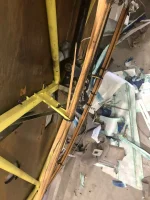
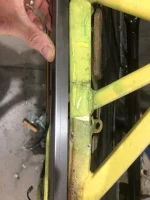
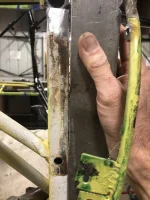
Time for an update! After a couple of months of languishing in a hangar, the plane is currently being worked on by the team at AmChamp. As they pulled more of the covering off the fuselage, they found quite a bit of damage including bent struts. Their theory is this plane had some sort of undisclosed damage in the past which was not properly repaired and likely contributed to the gear failure. It's now in the weld shop having it all repaired, obviously at great expense :).

With a few other modernizations it will end up costing almost $60k, making this very far from a good financial decision. For those following along insurance paid $65k, I paid $12k to buy the plane back, and this doesn't include the cost of the new propeller or engine overhaul. I don't really know what the plane will be worth with a 0SMOH engine in it, but it won't be enough! In any case not a good investment, but what's the fun in making good decisions?

IMG_0791.webp IMG_0792.webp IMG_0839.webp

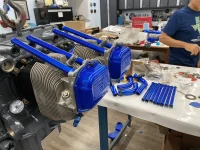
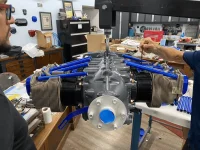
The engine is coming along nicely:

1605213432284.webp 1605213446151.webp
 
Metal spar wings installed in the 90s. They want $15k!? to recover the wings, so they’ll be keeping their existing covering.
 
My friends just had a badly damaged Chief repaired (fuselage welding) and recovered. Ten grand total! Select your shop carefully.
 
Back
Top