You are using an out of date browser. It may not display this or other websites correctly.
You should upgrade or use an alternative browser.
You should upgrade or use an alternative browser.
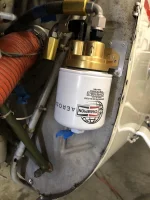
Citabria Remote oil filter or oil adapter
- Thread starter Rick
- Start date

BB57
Well-known member
- Joined
- Feb 20, 2020
- Messages
- 210
Yep..
Huge downside is the cost of the filters.
However; oil and oil filters are WAY cheaper than Lycoming or Continental engine parts...

Yes and no on the cost - it's mostly a wash. However, I am in total agreement on the engine parts costs.
Let's talk about my 7 KCAB first.
I run Aeroshell W100 Plus in my 7 KCAB. It costs my $9 per quart and I put in 6.5 quarts at each oil change.
The cost at each 25 hour oil change is $58.50 in oil, plus $1.75 for a new gasket for the filter housing when I remove the screen (and I remove the screen at each change). My IO-320 uses 1 quart every 12.5 hours so that's another 2 quarts ($18) in oil used each 25 hour oil change interval. That's $78.25 total, or $3.13 per hour over the 25 hour oil change interval. It's actually a little better than that, since I do an oil analysis every 25 hours as well, that increases my costs by about $25, or $1.00 per tach hour, after the analysis kit and postage are paid. That raises the total cost to $4.13 per hour with the oil screen.
I'm in the process of installing a Casper Labs adapter. Oil cost is the same per quart, the gasket won't need to be replaced and filters are $29.70 each. However, the oil change interval will be every 50 hours. Assuming oil consumption doesn't increase, I'll burn 2 more quarts of oil in the longer 50 hour interval, so the total cost will be $94.50 for oil plus $29.70 for the filter, for a total cost of $124.20. However, divided over 50 hours that is only $2.48 per hour. That's a savings of only $0.65 per tach hour. However if you add in the $25 cost of the analysis but with a 50 hour oil analysis interval, the hourly cost increases to $2.98 per hour, but also increases the cost savings to $1.15 per hour.
That means after paying $375 for the adapter, plus $50 or so for my mechanic to look it over and sign it off ($425 total), it will pay for itself in 654 tach hours with no oil analysis, or in 370 hours with oil analysis. Umm yeah, saving a whole lot of money there. What a deal.
Let's also talk about our Pacer.
Our PA-22/20-150 had an adapter on it when we bought it and it's been running on Phillips XC 20W50, which only costs $6.25 per quart.
If it had an oil screen, it would need the same gasket, and assuming the same 6.5 starting quarts, and the same 2 quart oil use over 25 hours, the cost would be $54.89 every 25 hours, or $2.20 per flight hour. With the same 25 hour analysis interval, the total cost is $3.20 per tach hour.
However, with a filter and a 50 hour interval, the total cost for 6.5 quarts of oil put in plus 4 quarts used in 50 hours is $65.63, plus $29.70 for the filter for a total of $95.33 or $1.91 per tach hour. With the less expensive oil, the savings with the filter is only $0.29 per tach hour and it would take 1466 tach to pay off a $425 adapter and install. If you add in a $25 oil analysis every 50 hours the hourly costs go up to $2.41 per tach hour and the savings per hour increase to $.79 per tach hour. The $425 install will now take 538 tach hours to pay off.
-----
Obviously, people are probably not going to install an adapter for the small decrease in direct costs, especially if they are using oil that costs around $6.25 per quart. But there are other reasons:
1) In my case, since I am flying about 25 hours per month, monthly oil changes are a bit of a pain, especially as I remove the oil screen housing to inspect and clean the screen.
2) At a minimum adding a filter will reduce downtime for the aircraft by a couple hours every month, which in reality equates to more like one day a month - more if you can't get it it that day.
3) Convenience wise, adding a filter will reduce the number of oil changes I have to do by half and eliminate the need to remove an oil screen. It will also reduce the waste oil I have to deal with by half.
4) Most importantly, it will mean removing small particles from my oil which should reduce wear in the engine over time and improve engine life. That's where significant cost savings might finally show up.
----
To be fair, if you are not doing your own oil changes, a filter can save you another $100-$200 in labor costs at each oil change and that will pay a filter off in less than a year with oil changes done every 90 days on a calendar schedule, even if you don't fly much.
Explorer
Well-known member
Talked with Bill at Casper Labs.
Very helpful...
Very helpful...

Rick
Well-known member
Thanks for all the input! I appreciate the groups knowledge and experience.
Rick
Well-known member
As for the parts list for the B&C: adapter, gasket, filter ( I believe it should take the short filter?) and the temperature sender adapter? thanks for the pictureB&C installed on a '96 7GCBC O-320. Seems to work just fine. No hoses to deal with or added stress on the firewall.
View attachment 2768

BB57
Well-known member
- Joined
- Feb 20, 2020
- Messages
- 210
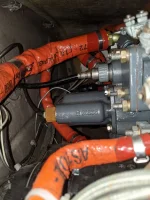
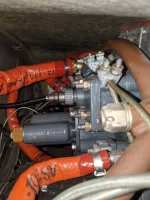
We did the install today for the Casper Labs adapter on my 7KCAB. It was fairly straight forward with three areas that needed attention.
1) There is only about 1/8" clearance for the tach cable - sufficient but not generous. The STC says 1/2" clearance is required, but that's an attorney covering collective butt as you'd never install one as you'd never have 1/2" clearance.
2) We also had to slightly rotate the fitting for one of the oil lines to get clearance for the filter.
3) There is a breather line from the crankcase to the separator on the firewall that touches the filter when it is installed. We put some sacrificial tape on it that'll need to be checked and if necessary replaced at each oil change to prevent the filter from rubbing through the breather line. A longer term solution would be to replace the hose with one that's an inch or two longer, but then you've got more hose flop.
It's all good though. I don't have to change oil as often and when I do, I won't have to mess with the bolts for the screen housing anymore, so the process will be a lot faster.
1) There is only about 1/8" clearance for the tach cable - sufficient but not generous. The STC says 1/2" clearance is required, but that's an attorney covering collective butt as you'd never install one as you'd never have 1/2" clearance.
2) We also had to slightly rotate the fitting for one of the oil lines to get clearance for the filter.
3) There is a breather line from the crankcase to the separator on the firewall that touches the filter when it is installed. We put some sacrificial tape on it that'll need to be checked and if necessary replaced at each oil change to prevent the filter from rubbing through the breather line. A longer term solution would be to replace the hose with one that's an inch or two longer, but then you've got more hose flop.
It's all good though. I don't have to change oil as often and when I do, I won't have to mess with the bolts for the screen housing anymore, so the process will be a lot faster.
Rick
Well-known member
When I called B&C today to make an order, they said ACA orders the 3/4" adaptor. But it looks like you didn't install one on your plane, would it have made the clearance or install easier/better?B&C installed on a '96 7GCBC O-320. Seems to work just fine. No hoses to deal with or added stress on the firewall.
View attachment 2768
Update: I also spoke with Dale at ACA, he also said they use the .75" adaptor.
Last edited:
BB57
Well-known member
- Joined
- Feb 20, 2020
- Messages
- 210
When I called B&C today to make an order, they said ACA orders the 3/4" adaptor. But it looks like you didn't install one on your plane, would it have made the clearance or install easier/better?
Update: I also spoke with Dale at ACA, he also said they use the .75" adaptor.
We used the Casper labs adapter.
WIth a .75" extension on it, it would have had clearance issues with the tach cable and I would have had to re-route the cable.
It still would not have avoided the breather line issue.
It would have definitely required the vernatherm to be installed before the adapter was bolted to the engine.
November67
Well-known member
- Joined
- Jul 23, 2019
- Messages
- 50
Does anyone know if the Casper labs adapter would fit on a 1967 7GCAA, or has fitted such an adapter himself on that type?
I know it's an old thread, but didn't want to start a new one. We fly ours since a month now after a couple of years restoring her.
This is what she looks like right now. We think it would be better for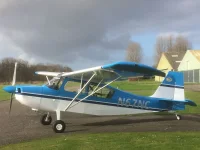 the engine and less messy during the oil change to have a filter, but there
is a lot less space under the cowling compared to a Scout or some other bigger types.
I know it's an old thread, but didn't want to start a new one. We fly ours since a month now after a couple of years restoring her.
This is what she looks like right now. We think it would be better for
the engine and less messy during the oil change to have a filter, but thereis a lot less space under the cowling compared to a Scout or some other bigger types.

Hiperbiper
Well-known member
I'm sure it will fit, we put one on a GCBC which is the same engine and mount.Does anyone know if the Casper labs adapter would fit on a 1967 7GCAA, or has fitted such an adapter himself on that type?
I know it's an old thread, but didn't want to start a new one. We fly ours since a month now after a couple of years restoring her.
This is what she looks like right now. We think it would be better forView attachment 5044 the engine and less messy during the oil change to have a filter, but there
is a lot less space under the cowling compared to a Scout or some other bigger types.
It IS tight and the best advice I can give is to use a shop hoist, pull the bolts on the top motor mounts and let the motor sag down a few inches...install the filter adapter and cinch everything back up tight. You may need to move the oil lines around a small amount but it'll work fine.
When Bill was looking for beta testers for his new adapter I stuck one on a Grumman AA1B...THAT was a tight install.
Happy filtering!
Chris
November67
Well-known member
- Joined
- Jul 23, 2019
- Messages
- 50
Thank you for the advise , Chris.
Guess we'll have to call Bill Ryan at Casper to ask what we need for our configuration and probably send him some picturess.
Filtering sounds happier than screening....
Guess we'll have to call Bill Ryan at Casper to ask what we need for our configuration and probably send him some picturess.
Filtering sounds happier than screening....
Hiperbiper
Well-known member
BTW, pretty plane!
Does the white/blue/dark blue paint job and the NC perhaps denote an homage to a particular NFL team?
Just wondering...
Chris
Does the white/blue/dark blue paint job and the NC perhaps denote an homage to a particular NFL team?
Just wondering...
Chris
November67
Well-known member
- Joined
- Jul 23, 2019
- Messages
- 50
Sorry Chris, any similarity to actual teams, living or dead, is purely coincidental, but thx for the compliment!
If you Google on N67NC you can see what it looked like when we bought it. We had to remove the fabric from the wings to
inspect the wooden spars and dicided to replace them with alu ones, to prevent that from happening again.
While we were at it, we took on the rest of the plane as well, didn't like the the false teeth in the former livery....
If you Google on N67NC you can see what it looked like when we bought it. We had to remove the fabric from the wings to
inspect the wooden spars and dicided to replace them with alu ones, to prevent that from happening again.
While we were at it, we took on the rest of the plane as well, didn't like the the false teeth in the former livery....