Spin training

I fly with some really neat folks who have iPads tuned in to nearby N-numbers. One can truly get sucked in by the magic - but never forget - some of us are legally operating without ADS-B. You need eyeballs to see us.
 
First time I did acro, just a few loops and rolls, I came home, turned off the lights, and lay on the sofa for several hours. Kicked my ass. After a few months, I could practice hard for about 30 minutes without feeling bad. Could do 2 or 3 sportsman sequences in a row and feel fine. You really do build up a tolerance.

Part of it is psychological, tbh. When you first do acro you are scared, or at least anxious. But a bigger part of it is your body learning to anticipate sensations. When you are in control and you know what to expect, it bothers you less.

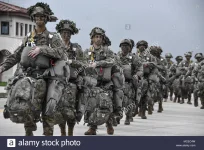
I am retired Army. Used to jump out of C130's. In exchange for giving us a free ride to whatever base we wanted to train at, the Air Force got to train on Nap of Earth flight before the drop. After 30 minutes of that, every paratrooper in back was puking their guts out. And these were hard, tough, physically fit men. But the sensation of G forces with no visual reference is brutal. Once one guy barfed, it started a chain reaction. Funny if it wasn't so miserable.

IMO once a week is sufficient to build up tolerance, unless you are talking advanced or negative G stuff.
 
well thank you for your service Ed. that's pretty funny, everybody puking but how do you jump out of a plane right after being so sick? or do they do that to condition everyone since it's about war and not a jump club?

i'm making progress, next up is loops then I'll be able to link the first three elements of the current primary known, which is a big deal for me! lol
 
Static line tactical jumping is pretty simple. You usually have a crapload of equipment strapped to you, so you just waddle to the door and step out. Once you get a half step out the door the slipstream takes over and you are debris. Doesn't matter how sick you are as long as you can walk and fall. It's usually dark so you float for 30 seconds, then smack into the ground and hope it is soft. A certain injury rate is accepted.

paratrooper equipment.webp

Loops are the foundational maneuver of aerobatics. Immelman, Split S, Cuban/Rev 8, hammerhead, all are just parts of a loop with some variation.

My advice is get some help and put in the effort to learn to do good quality competition loops. Don't just pull and hold. Work on getting it nice and round. That requires varying your pull at different phases of the loop, which teaches you energy management and controlling your g-load. In other words, it's not about the pretty loop, it's about what the pretty loop teaches you.
 
Loops are the foundational maneuver of aerobatics. Immelman, Split S, Cuban/Rev 8, hammerhead, all are just parts of a loop with some variation.

My advice is get some help and put in the effort to learn to do good quality competition loops. Don't just pull and hold. Work on getting it nice and round. That requires varying your pull at different phases of the loop, which teaches you energy management and controlling your g-load. In other words, it's not about the pretty loop, it's about what the pretty loop teaches you.

I've done a fair bit of off shore wreck diving. Think small boat 20-30 miles off shore in 6 ft waves with a 8-9 second interval. A few hours of that and you're happy to jump in, just to get off the boat. In needed you can puke through a regulator. On a rebreather, you need to bail out to open circuit, puke, then get back on the loop. Either way, the nausea subsides a minute or two after you are in the water and below about 20'.

-----

Doing good loops in a Citabria teaches you a LOT.
 
Found this while searching. An engineering grad student at the Air Force Institute of Technology (AFIT) did her research thesis on Spin Recovery in the Decathlon. Flight testing and statistical analysis on results. 268 pages. All the hard data you could ever want and then some.

According to her results, fastest recovery is simultaneous application of opposite rudder and neutral to slightly forward stick. Rate of altitude loss is 3 rotations per thousand feet.

She also noted full forward stick results in transition to inverted spin and failure to recover. Historically that has been a common failure mode in the Pitts, where the spin rate is so fast that pilots get disoriented and cannot detect the transition. Decathon spin rate is 3 seconds per rotation, while Pitts spin rate is 2 rotations per second. Yikes.
 
That tracks. You can also get rotation reversal, adding to the confusion.

Again, a proper entry and a proper recovery with a down line is a thing of beauty. Letting it wrap up is a waste of altitude and fuel, at a minimum. Opinion,still.
 
Don't overthink the head movement thing. As you progress more into aerobatics, you are going to be moving your head all over the place. You have to constantly change where you look to maintain visual reference with the horizon and track your linear feature on the ground. The loop is great for teaching that.

It's really just a matter of getting enough experience to get used to the physical sensations AND reduce the anxiety. I am firmly convinced airsickness is 50% psychological in nature.

My first 1 hour lesson wiped me out. By the time I had 10 hours it was no problem.
 
Again, a proper entry and a proper recovery with a down line is a thing of beauty.

One of the great things about training to competition standard is that it requires precise application of anti-spin controls, rather than just blind mechanical input. It also requires you to separate rudder and elevator input, which breaks the recovery down into phases. Very useful for understanding what is happening and actually flying the airplane, as opposed to just slamming in a memorized sequence of inputs.

First, opposite rudder 1/4 to 1/3 rotation before your desired recovery heading. If you time it right, rotation slows right as you approach heading. Then, neutral rudder and just enough forward stick to break the stall and put you on the vertical down line. That sequence helps you learn to avoid inversion and reversal.

I have run into several CFI applicants over correcting and snapping the stick forward so far that they induce negative G on the wing.

To me that sounds like fear. Until you spin and recover, you are afraid of it.
 
Curious what set up you folks use for spin entry. I've haven't done any this year but over the past two days I've dabbled. This is my 150hp 7ECA by the way.
First off, my plane will NOT stall in power off configuration. At idle you can decelerate until the stick is fully back and the airspeed sits on the peg. Ball centered it will descend at 6-700fpm. In cold air it won't even burble. In warm air it might nod a little.
Power on in departure configuration would be a freak show before it will break.
So the other day I went up and started by repeating what I know about my plane's behavior and confirmed it is as described above. Then I proceeded into spins.

From my early CFI days I knew the easiest way to spin a C152 or C172 was departure stall, full power and let it get uncoordinated to the left. P factor and all the other left turning tendencies could be assisted by left rudder just as it breaks.
Then over she goes, with recovery by the book.
I decided to try 2000 rpm and 30 degrees of pitch. Ball centered I could finally get a break, favoring a right spin (Just slightly, and easy to pick up the wing with rudder if a spin was not my intent).
Thinking back now, I actually did do some spin entries earlier this year, forcing them to the left. In that case relaxing the left rudder at all resulted in instant recovery.

Today I did several 1 turn spins, all to the right since that's what it's favoring. Even with stick fully back and about half right aileron to provoke upset it would recover by itself in less than a turn, and just be in a steep spiral.
Yes, my CG is well forward in this plane but not at the forward limit. In fact just ran the numbers and I was at 13.3"
I had cameras running so I'll see if anything is worth editing this evening.
 
Curious what set up you folks use for spin entry. I've haven't done any this year but over the past two days I've dabbled. This is my 150hp 7ECA by the way.
First off, my plane will NOT stall in power off configuration. At idle you can decelerate until the stick is fully back and the airspeed sits on the peg. Ball centered it will descend at 6-700fpm. In cold air it won't even burble. In warm air it might nod a little.
Power on in departure configuration would be a freak show before it will break.

My 7KCAB is the same when I'm solo and down under half fuel. Power off, it'll bob with the stick full aft stick. I can just hold the stick back and keep it straight with the rudders and it'll come down, although my VSI says it closer to 800-1000 fpm after a bit.

Full power on stalls this evening were the same when loaded light with an impressive deck angle, and plenty of warning with some burble and a nod as it breaks - if you can call it that. I suspect punching full left rudder at the nod would probably be interesting.
 
Every Decathlon I have flown (5) spins and recovers easily, with all favoring the left. There is an aerodynamic reason for the left preference but I forget what it is.

Entry is power off, maintain level flight as speed decays, full stick back and full left rudder at the stall break. Recovery is full right rudder 1/3 rotation prior to desired heading, then partial forward stick and neutral rudder on heading. For competition spins, add full power and push forward to vertical dive, set the line, and recover.
 
My competition was sportsman, at 2500'. As I recall, power was at idle through recovery and level off.

To enter a spin deliberately you need to slow down to the buffet, then jam full left rudder and full back stick. If that doesn't do it, do the same with a little power. Once you are at stall speed, being gentle with stick and rudder will get you a gentle stall. No full rudder, no spin.

That's not to say that folks cannot inadvertently enter a spin - just doing so from level flight with ball in the middle takes some fairly sharp control inputs.
 
so there seems to be a trick to getting a nice clean spin entry and transition in order to avoid the "spiraling downward" fail mode. Power off, maintain altitude as airspeed bleeds off and just before where you'd anticipate the stall, bring the stick quickly full back and apply full rudder in the direction you want to spin.

if you catch it just right, you're at an airspeed where there won't be enough energy where an abrupt input of full up elevator will change the aircraft's flight path. There will be just enough energy to jump past the mushing stall entry and induce a clean stall without altitude gain. Add the rudder with only a hint of delay to convince the judges that you stalled and then spinned and you'll fall right down into it.

hit full opposite rudder at about the same time you're bringing the stick to center and it stops pretty quickly.

I recall doing spins with a guy in his Citabria as he was checking me out a long time ago and the first one I did I abruptly pushed the stick too far forward and gave us both a surprise! He reacted audibly and I popped up a bit against my restraints as the nose tucked under but we stayed straight in the recovery. Have tried to not do that again!
 
Agree with Bob and Bart, the trick is pop the stick back a half-second before the stall so you get a clean nose drop instead of a mush, and full rudder a quarter second after that. At least that works great with the 8KCAB. I can't speak for the 7 series. Could be that flat bottom wing just don't wanna stop flying.
 
They spin just fine. I have spun the 115 7ECA and my practice airplane for Sportsman was the 7KCAB. We even did an inverted spin in that one.
 
Back
Top