1979 Decathlon CS rehab

Agree. My Dec is butyrate, applied in the last century. Beautiful! My repairs are almost invisible. (Went to small N-numbers, and had to do some cutting to install a balun for the nav antenna).
 
I was planning on doing all of my metal and fiberglass parts with Nason automotive polyurethane enamel, less than half the price of Mark II. The local supplier uses a computer color match system. The poly will be glossier than my dope but I'm ok with that. On the fabric I'm a fan of dope. In addition to easy repairs, it is just much easier to spray. Which makes me look like I know what I am doing. I will keep you posted on how the polyurethane comes out.
 
I was planning on doing all of my metal and fiberglass parts with Nason automotive polyurethane enamel, less than half the price of Mark II. The local supplier uses a computer color match system. The poly will be glossier than my dope but I'm ok with that. On the fabric I'm a fan of dope. In addition to easy repairs, it is just much easier to spray. Which makes me look like I know what I am doing. I will keep you posted on how the polyurethane comes out.

Does the Nason require a cyanide-based catalyst? That's the part that keeps me away from PU paints.
 
I believe the factory uses automotive finish paint. If so, you can, too - legally. The problem is - in the 1990s the feds made holders of fabric STCs specify the finish coat.
I use the 1969 Stits STC, so I can finish with anything I want.
Be sure to get a flex agent added - consider Airtex finish.
 
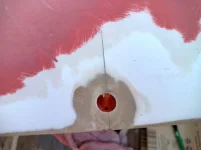
I had figured it would take a Saturday to have the cowling ready to paint. A month later I am still finding little spots to patch and sand. Just talking about it has made my forearms start to itch again.IMG_20220226_142706_HDR.webp
 
Rebuilt with two layers of glass top and bottom. You can see an outline of the original oblong hole.
 
Need to do something similar with my wheel pants. What did you use to lay up the glass layers? West Epoxy?
 
epoxy is the strongest of the resins but with the lowest temp tolerance. polyester is the weakest but with the highest temp tolerance. vinylester falls in the middle of both epoxy and polyester for both qualities.

i used vinylester to coat the inside of my lower cowl and it worked well.

epoxy sticks to polyester but not the other way around. greenish resins are usually polyester.

epoxy would probably be fine for wheel pants but check what AC43.13 has to say about it.
 
I'd think with the wealth of 43.13 guidance available the case for minor repair is an easy one. I'm using polyester resin. I believe that is what Bellanca used, but someone may need to correct me here because I do not know where I came up with that assumption. I'd image that vinyl ester could be an advantage in areas close to the exhaust. Away from the heat Epoxy is likely a higher strength option. Cleaning, grinding down to fresh fiberglass, and tapering the repair for a wide bonding area will be important. I literally peeled some old repairs out of my wheel pants that were delaminating, it was pretty obvious that their prep work was bad. On the fastener holes I tapered them front and back out to about a one-inch radius, built them up, then sanded it back as close as I could to the original thickness. On the rest I filled and sanded all the cracks in the gel coat and added reinforcement from behind anywhere it looked like it might help. The wheel pants really take a beating. Every reinforcement that one needed I added to the other as preventative maintenance.
 
Last edited:
I literally peeled some old repairs out of my wheel pants that were delaminating, it was pretty obvious that their prep work was bad.

I hope that wasn't because they put polyester over epoxy. Polyester won't stick to epoxy but epoxy will stick to polyester and epoxy is stronger. When in doubt, unless there's high heat nearby, epoxy is the better option if it can be demonstrated to also be legal for the repair. Not sure how legality is determined other than like materials used for repairs as original manufacture?
 
right, I remember reading through 43.13 looking for guidance and not really finding it. maybe one of you guys will find it in there.
 
I hope that wasn't because they put polyester over epoxy
It was pretty obvious that it had not been cleaned or scuffed up under the repairs. I haven't found any advice about resin in 43-13-1b other than to use like materials.
 
I was addressing the legality question. Intro for AC 43-13.1b states that contents can be referenced by para as acceptable data for minor repairs in the absence of a manufacturer specified repair method. So first step would be checking Bellanca or ACA service manual. If nothing there, the AC is the legal source.

Chapter 3, Fiberglass and Plastic repairs, section 3.1 non-structural repairs just says use low temperature "resin". But it also recommends due to variety of materials that a destructive test be used to verify bond. In other words, mix up a batch of resin, glue a patch to the original material, then tear it off. If results are satisfactory, sand it off and proceed with repair.

Section 3.3 on structural repairs specifies "viscous epoxy resin", or so I recall from skimming it.
 
Back
Top