
Rick Ludtke
Member
Hi Bart,Hi Rich,
Thanks for stopping by to post about your survey. Generally speaking, the category of airplanes we're discussing here are usually VFR only with very limited instrumentation. Even if there was a desire to install the instruments to make them IFR we're still talking about light planes where every pound of useful load is valuable. There are some Citabria variants where IFR equipment is routinely installed but those are more in the category of utility use where IFR certification makes them more commercially viable.
Having said that, the factory is moving towards autopilots in new planes and the interconnect between the two control sticks now includes a lug for attachment to an autopilot servo so we may be something of a market for you, more than we'd like to admit.
Can you maybe summarize what your system would replace and a summary of the weight of the components we'd be able to remove and what your replacement components would weigh?
I like the idea of a flat panel with attitude, heading, moving map, weather, traffic and engine displays all incorporated, especially if the black box driving everything is tolerant of aerobatics but I'm not well versed in these things except at work where I am forced to stare at these types of displays for long hours at all times of the day/night.
Thanks again, glad you found us, and looking forward to your reply. By the way, that little Pitts, is that from the Midwest kit and did you post a picture of it to FB recently?
Regards,
Bart
Thanks for responding!
As you know, American Champion sells complete Garmin EFIS systems in the new airplanes. I wanted to do two things with this post. The first, expose owners of these types who may be needing a panel refresh to the possibilities of Dynon SkyView HDX for far less money than the Garmin option on the new airplanes. Second, rather than assume there would be no interest in autopilots in this airplane market segment, try to learn if this group of owners actually did have interest in an autopilot.
This is because autopilots are becoming mainstream in general Aviation, like it or not. I grew up in and learned to fly in "old school" aviation, and even after coming to work for Dynon, wasn't firmly on the autopilot bandwagon, even though I designed autopilot and autothrottle pilot/system interfaces for The Boeing Company for many years. Autopilots are a work-load reduction tool that can enhance safety. And once I got over my "old school" self, realized that there isn't any good reason to keep GA from having the option to experience the same benefits in any aircraft.

I took the liberty of laying out what the system could look like in a Decathlon panel, as you can see there is a lot of room for other equipment. But the only thing Dynon can't provide that would be truly necessary is an intercom.
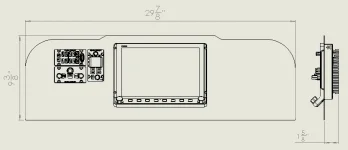
A complete VFR system with one 10" screen would consist of the following...
Panel Mounted Equipment:
SV-HDX110010" HD Touch Screen Display (a 7" display is also available) - Can provide the Primary Flight Display (PFD), The Moving Map NAV display, and the Engine Monitoring System display, among others.
EFIS-D10A Standby EFIS Display - Constantly provides Flight Information for cross-comparison and immediate availability if the Primary Flight Display source is lost.
SV-COM-X83 VHF Com Radio Control Panel (optional) - Provides interface with remote mounted Transceiver. Available in vertical or horizontal arrangements. Features tune by airport functionality.
SV-KNOB-PANEL Knob Control Panel (optional) - Available in vertical or horizontal arrangements. Provides direct-access controls for setting altitude and heading bugs, as well as the barometer.
Remotely Mounted Equipment:
SV-ADAHRS-200 Air Data, Attitude, Heading Reference System module, with OAT sensor - Generates the PFD.
SV-MAG-236 Remote Mounted Magnetometer - Allows the magnetometer to reside in a location on the airplane away from magnetic disturbances.
SV-GPS-2020 GPS Antenna/Receiver - WAAS-enabled, high-sensitivity, weatherproof, externally mounted GPS receiver/antenna.
SV-BAT-320 Back Up Battery - Provides the display and its systems a minimum of 45 minutes of electrical power.
SV-EMS-220 Engine Monitoring System module (optional) - Provides visibility of all engine parameters, alerts, and an integrated fuel computer.
SV-XPNDR-261 Mode S Transponder with ADS-B Out module (optional) - Requires no control panel, control menu is accessed on the display.
SV-ADSB-472 Dual Band ADS-B Receiver module (optional) - Provides traffic and weather on the PFD and MAP displays.
SV-ARINC-429 ARINC-429 interface model (optional) - Provides an ARINC-429 protocol interface with GPS IFR Navigators so that IFR flight plan will be displayed on the Map.
If an autopilot was available:
SV-AP-PANEL Autopilot Control Panel (option, as the autopilot can be controlled by a display menu) - Provides a panel-mounted interface for selecting control modes etc.
2 each SV32 or SV42 Servos, and a kit of installation mounts and associated installation hardware.
The display units are the heaviest pieces of equipment, with the 10" weighing 3 pounds. The Transceiver and Transponder modules each weigh one pound. The weights of very other module and control panel are just a few ounces each. Even with all the options, SkyView HDX will weigh far less than the equipment in the panel it replaces, while adding many more functions that didn't exist before.
SkyView HDX has a configurable automatic dimming system, along with the ability to be manually adjusted with an external control knob. All of the control panel back lights are connected to the dimming system. Plus, SkyView HDX has dimming signal outputs that can connect with third-party equipment to provide central control over all of the panel illumination.
Aerobatics do not present an issue for SkyView HDX. SkyView HDX can present Primary Flight Information in two different ways: The Primary Flight Display which has become the standard for primary flight information on electronic display systems, or an emulation of the traditional 6-pack. I mention this as some people prefer to monitor needles when performing aerobatic maneuvers. SkyView HDX provides the ability to do so at a touch of a button if desired.
I did recently post a picture of my 45" 1/5th scale scratch-build Pitts S-1 for electric R/C. This was designed using the original Pitts drawings left over from an airplane my father and I built. The geometry is accurately scaled, and it flies very much like the S-1E I used to compete with before I entered family-hood. The Pitts hangs in my office now, I haven't flown it in a while as I have been building a Vans RV-6.

I hope this answers all of your questions adequately.
Rick


