fabric repair

About to start gluing stuff. Can the 3M be used for fabric to metal? Painted surfaces? Vinyl headliner?

there's a glue for the headliner, if you don't come up with something I'll run over to the hangar and tell you what Airtex sent me when I bought the headliner.
 
there's a glue for the headliner, if you don't come up with something I'll run over to the hangar and tell you what Airtex sent me when I bought the headliner.
I should have bought the airtex stuff, I suppose. When you get a chance, please let me know.

Did you use the 3M stuff for fabric to frame?
 
Yes, the 3M 30NF is used to glue the fabric to the frame. Vacuum everything or blow it clean with compressed air, give it a quick wipe with alcohol and the glue goes right onto the powder coat.

Two details about the process, you need to brush it on so that you have adequate film thickness without runs or buildup so it's a bit of a learned skill. 2nd, when you wipe the fabric of excess glue, don't press too hard, it only takes a little pressure to remove the excess glue without squeegiing (squeegy-ing) every last bit of glue out of the fabric.

I'll take a look tomorrow morning at the can of contact cement for the headliner.
 
Yes, the 3M 30NF is used to glue the fabric to the frame. Vacuum everything or blow it clean with compressed air, give it a quick wipe with alcohol and the glue goes right onto the powder coat.

Two details about the process, you need to brush it on so that you have adequate film thickness without runs or buildup so it's a bit of a learned skill. 2nd, when you wipe the fabric of excess glue, don't press too hard, it only takes a little pressure to remove the excess glue without squeegiing (squeegy-ing) every last bit of glue out of the fabric.

I'll take a look tomorrow morning at the can of contact cement for the headliner.

ACA says use 3M weatherstrip cement for the headliner, so I am good there.

Do you apply the 3M to both surfaces, let it dry, and then press to adhere, like true contact cement? Or do you lay the tapes in the wet glue and put more on top?
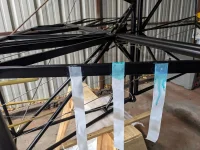
 
Thinking about it, in most places the fabric forms an envelope after gluing, so bonding strength to metal is less important than fabric-to-fabric strength.

Example: the h-stab top and bottom sheets are glued together where they overlap. Shrinking pulls the fabric tight on the frame. It really does not matter if the glue sticks to the metal. The taped seams are the important part.

However ... I have seen 2 relatively recent ACA aircraft with loose fabric where the fabric is glued to metal and does not have overlapping fabric to hold it in place. One was on the back window rear channel. The other was on the front edge of the fuselage envelope, where the boot cowl meets the fabric.

The 3M manufacturer instructions do not recommend bonding to metal. That makes me wonder.

I'm going to conduct a few tear-off tests to compare 3M strength to Poly Tak. If the results are significantly different, I might use Poly Tak for edges where fabric-to-metal bond is important. Both glues are listed in the spec.
 
The factory technique was to attach fabric to metal with Pliobond. I have uncovered a few factory covered parts, and can tell you it does not like to let go.
My buddy did his J3 in Stewarts, and where the fabric wraps around a stringer under the boot cowl we may be having problems.
I do like the Stewarts glue and Eko-fill, but will not soon be attempting their top coat. I just shot a Stearman elevator repair with Poly Tone - and with HVLP help, got a gloss finish!
I get my best results with butyrate, along with wet sanding and polishing compound.

So - maybe super seam cement, and wrap the fabric at least 180 degrees if no other fabric is to be glued thereon - opinion.
 
The factory technique was to attach fabric to metal with Pliobond.
If that is the brown hard gunk that was on my frame from the Bellanca cover job, you are right, that stuff is bulletproof. Unfortunately it is not listed as an adhesive for the ACA process. I plan to stay 100% legal so my IA has no qualms signing off on my work and submitting the 337.

3M 30NF, Super Seam II, Poly Tak, Cecobond, and Super Flite are listed in the spec. The factory uses 3M 30NF for everything. I am leaning towards as you described for fabric to metal with no overlap: Super Seam or Poly Tak and wrap the fabric 180. I am fairly confident that Super Seam and Poly Tak are the same substance with a different label. 3M 30NF wherever fabric overlaps. But I will do a strength test so it is not supposition.

@Bartman is the 30NF used as a contact cement? Eg do you coat both surfaces, let dry, then press to adhere? Or do you lay the cement wet and then press the top layer into it? Do you put more cement on the top of the top layer of fabric to soak through the weave?
 
Ed,

There are a few different methods, suggest you watch the videos below for using 30NF. You can brush it on, let dry and then press/iron fabric into it followed by brush-through of more adhesive followed by wiping. You can put the fabric down and just brush adhesive through it followed by wiping, this is what is done with tapes. You can also brush base coat, place fabric tape, and then brush-through followed by wiping. The adhesive has no tack or bond strength when wet so when it's applied wet you have to iron over everything after it dries to ensure bonding and tight edges. For patches you can trace the area and pre-brush, also brush/wipe adhesive into fabric scrap before cutting a patch and then iron the dried patch onto the pre-glued spot. That's what I've come up with so far. You can't go too heavy with the glue from the brush but you can't try to stretch it either to get the right film layer.

30NF is a favorite amongst the experimental crowd and it's factory approved so I'm pretty sure anything that is done with it, if it's done correctly, it'll be just fine. The dried glue has crazy tensile strength but you can rub it off the painted surface of steel parts with an eraser or your finger if it's got some glue dried on it which is unavoidable if you're anywhere near the stuff!


Last edited:
Do you apply the 3M to both surfaces,
ed,

For the headliner, apply glue to both surfaces, let dry/tack, then stretch and press into position followed by square tubing with spring clamps in the window angles and a hellacious number of staples in the wood. I bought a cheap pneumatic stapler at Lowes with stainless staples and two dozen cheap spring clamps on Amazon. Worked great.
 
Last edited:
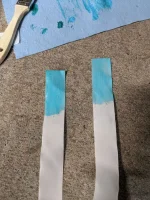
Did some comparison tests. I glued 1" Dacron tapes to powdercoated metal, and also to other tapes. I tested the following:

Super Seam II
3M 30NF as wet cement
3M 30NF as contact cement

Results:
Fabric to fabric: All 3 methods were extremely strong in shear. All 3 methods were moderately strong in pull away.
Fabric to metal: all 3 methods were strong in shear. Super Seam was moderately strong in pull away. 30NF was weak in pull away.

Discussed with my A&P. I am going to use 30NF for all locations where there is fabric to fabric bonding. Where there is only metal to fabric contact, I will use Super Seam.
PXL_20221210_022458667.webpPXL_20221210_022653539.webp
 
While I agree with that in an engineering sense, do the STCs support it?

I have found that minor repairs using Stewarts glue and Ekofill are superior. We get away with it because they are minor alterations. I do not spray catalyzed anything.
 
Interesting... am I understanding this correctly? ACA suggests applying tapes with super seam or polytack when the polyfiber system applies them with poly brush? I'm going to use the 3m around the skylight but polytack every where else to attach the envelope.... but I'd never considered using polytack for application of tapes.
From my experience this could be nice considering pinked edges don't always seat properly and need to be chased with an iron....
 
Interesting... am I understanding this correctly? ACA suggests applying tapes with super seam or polytack when the polyfiber system applies them with poly brush? I'm going to use the 3m around the skylight but polytack every where else to attach the envelope.... but I'd never considered using polytack for application of tapes.
From my experience this could be nice considering pinked edges don't always seat properly and need to be chased with an iron....

looking at the PolyFiber manual, it looks like their recommendation is for Poly-brush with poly-fiber fabric but Poly-brush isn't in the factory specs. Which covering spec do you intend to follow? If Poly-fiber has an STC then you would use their spec exclusively if that's what you want to do. If using the factory spec, I'd call and talk to Dale if you want to use the Poly-fiber materials but are not sure about attaching tapes.

another interesting detail, in the Ceconite/Randolph manual it says to not attach tapes with Super Seam as it is too brittle. The factory spec leaves a lot to be desired but they might want it that way so they have more wiggle room or less liability.
 
Bartman is correct, if you are doing the Polyfiber STC you must follow not only the use the correct products you must follow the STC procedure and instructions. On certified birds of course.
And why would anybody who wants a great looking finish want to deviate from the instructions? In the case of The Polyfiber system it has been used since the 1960's to produce award winning finishes on airplanes and has a documented history of use when applied correctly.
In the case of using Polytack to attach tapes; its been tried. I've seen the results. It's ugly. Polytack is too thick (even when thinned with MEK) to flow out and wet the tapes...it drys too quick and thick and produces a slick, un-uniform and lumpy area and will give the paint topcoat a mottled and striped appearance because the fabric weave and pinked edges beneath the primer/paint is too full of glue. And use Polytack around the skylight too...it works just fine, just as it has for 60 years or so...
If you're having a problem with the pinked edges (ears) popping up try using less Polybrush on the brush while putting the tapes on...a dry brush helps the ears dry quicker and pop up less. Same with when you shoot the following coats of Polybrush and Polyspray...too much product will cause the tapes and PATCHES (nee:reinforcements 🙂) edges to curl. Not a problem with the Polybrush (you can iron them down) but a PITA after Polyspray 🤬.
Remember; the finished paint job will reflect the care taken in the preparation of the underlying surface...paint will not only show any imperfections but actually highlight them!
Hope this helps.

Chris
 
When a truly bulletproof way comes along let me know. I have great success with most STC systems,but we have this 160 Cub that cannot keep fabric on the landing gear vees. I re-did them in Stitts two years ago, and already the tapes are coming off.

We also have a 160 GCAA with factory cover - the underside of the right wing has been re-done several times (once by a very expensive professional outfit) and I am forever re-glueing tapes.

My personal Cub was done in Stits in 1973, and except for the gear legs has held up exceedingly well, even with acrylic enamel on the topcoat.
 
Ya I've pretty much seen it all .... just not poly tack on tapes.
And yes I get the stc angle.... thoroughly.
Had a 53 tripe with polyfiber and polytone ... rejuvenated repaired and repainted
with aerothane, no problems.
I'm totally curious about consolidated products being used by the factory
Outside of the stc'd manual requirements
 

Attachments

  • 20161028_133320 (1).webp
    20161028_133320 (1).webp
    174.4 KB · Views: 13
  • 20161028_133426 (1).webp
    20161028_133426 (1).webp
    151.5 KB · Views: 14
Last edited:
Back
Top