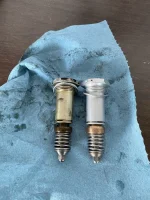
Citabria High Oil Temps

hmmm, i see why you think you've got a problem somewhere. good luck getting it worked out. i'd be surprised if it was the oil cooler but weird stuff happens in airplanes so anything's possible. vernatherms's aren't bullet proof, so good luck swapping it out.
Yea it definitely seems odd to me. I can certainly test the indication while I’m at it. I also plan to do a quick test flight, de-cowl it immediately and see if the cooler is warm or not. If it’s not, that would certainly indicate to me that oil isn’t flowing through it. I knew I’d have little issues like this when I bought an airplane that hasn’t been as active as it should have been. All part of the fun I suppose.
 
Does seem high. I struggle to get my 8KCAB heated up to 180 in Florida on a 30 minute acro sortie.
 
Download a copy of Lycoming Service Instruction SI1316a
prior to replacing the vernatherm...
More often than not the sealing surface of the seat is conforming to the surface of the pintle (it doesn't have a rotater) and without doing a lap job on that seat your new vernatherm will make the bypass problem worse, not better.

Chris
Will do. Good suggestion.
 
Well, possibly a solution, but probably not:

I went today to do an oil change today, and decided to attempt to get some crude date points in the process. Decided to go for a flight to warm the oil to make it easier to change. Flew at 1500' and 2400RPM. On returning to the field, I saw the oil as high as 225-230 indicated:
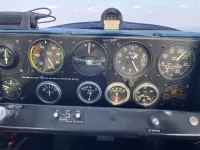
tempImagerHpV0K.jpg

After the oil change (changed from 15w50 to W100), and assuring that all baffling was correct, I replicated the flight exactly and only saw the temp reach 210-215 indicated.
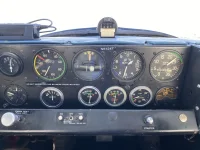
tempImagewFdeIU.jpg

I did have the throttle pulled back more on the first flight near the end the help the temps come down. You can see the lower RPM and lower airspeed in the first pic vs the 2nd.

The only thing I noticed that was POSSIBLY giving me higher temps prior to the change is that I'm not 100% sure the baffle on the left side of the cowl by the cooler was forward. When I re-cowled it after the oil change, I noticed it was VERY easy to get that baffle seated wrong. So I took care to make sure it was 100% correct. So I think MAYBE that could have been a factor. Either way, a near 20 degree reduction is progress. I'm planning to take it on a trip this weekend so we'll see how it goes.

Also, I do believe at least some oil is flowing through the cooler, as it was hot to the touch after the flight. Not as hot as the filter housing, but still plenty warm:
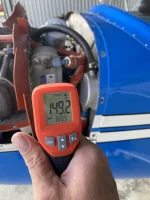
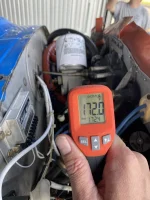
tempImageksQauJ.jpg
tempImage3wh6x4.jpg

I don't know, maybe I'm way down the rabbit hole here. I just think the temp still seems high for an aircraft with a cooler.

I have the new Vernatherm, but I figured I'd try changing the oil and double checking the baffles before I start throwing parts at it. After this trip if its still an issue, I'll pull the vernatherm and take a look at the seat with a borescope.
 
I understand the desire to make sure it's doing what it's supposed to do and I commend you for your detail oriented approach to troubleshooting the problem but that gauge has so little resolution in the range you are concerned about that you should probably check that it is reading the upper limit accurately (about 200 to 230) before throwing parts at it. Water boils at 212 so maybe if you could get a sustained 210 from a pot of water and just mark that spot on the gauge with some tape or something, you'd know what you're looking at when the engine is running.

Glad to see though that you got some improvement by looking at the baffling. :) What do you figure the outside air temp was?
 
I understand the desire to make sure it's doing what it's supposed to do and I commend you for your detail oriented approach to troubleshooting the problem but that gauge has so little resolution in the range you are concerned about that you should probably check that it is reading the upper limit accurately (about 200 to 230) before throwing parts at it. Water boils at 212 so maybe if you could get a sustained 210 from a pot of water and just mark that spot on the gauge with some tape or something, you'd know what you're looking at when the engine is running.

Glad to see though that you got some improvement by looking at the baffling. :) What do you figure the outside air temp was?
That’s definitely next. My mechanic has another gauge we can use to compare as well.

It was 90°F yesterday
 
Actually I don't think you have a problem at all...210°-220° is a good temp for that engine. Well within limits from both Lycoming and Aeroshell/Phillips/Exxon.
The delta between 220° and 245° (max allowable indicated) is actually quite large and if the cooler wasn't working (bypassing) you would see numbers higher than you're seeing.
Also remember that due to the less-than-optimum placement of most oil coolers on airplanes the coolers need the plane to be moving as fast as possible at high power settings (climbs) to scrub the heat from the cooler.
Lowering the nose a bit and climbing at 100 mph instead of 80 not only shoves more cooling air into the top of the cowling (engine) but it creates more low pressure area in the bottom of the cowling helping to suck the cooling air thru the cylinder fins, oil cooler etc. and out the bottom of the cowling.
Long, slow airspeed climbs put the cooling systems in absolutely the worst condition...

Chris
 
Actually I don't think you have a problem at all...210°-220° is a good temp for that engine. Well within limits from both Lycoming and Aeroshell/Phillips/Exxon.
The delta between 220° and 245° (max allowable indicated) is actually quite large and if the cooler wasn't working (bypassing) you would see numbers higher than you're seeing.
Also remember that due to the less-than-optimum placement of most oil coolers on airplanes the coolers need the plane to be moving as fast as possible at high power settings (climbs) to scrub the heat from the cooler.
Lowering the nose a bit and climbing at 100 mph instead of 80 not only shoves more cooling air into the top of the cowling (engine) but it creates more low pressure area in the bottom of the cowling helping to suck the cooling air thru the cylinder fins, oil cooler etc. and out the bottom of the cowling.
Long, slow airspeed climbs put the cooling systems in absolutely the worst condition...

Chris

I actually disagree after a long talk with the previous owner. I read the logs wrong, the cooler is much older than 2019. He noticed it starting to run warmer than usual (180 was normal, it was getting a little over 200). So they changed the cooler back in 2012 and it was back to normal 180ish). He then lost his medical in 2019 and the plane has only flown a few times since, until I bought it in January 2022. It’s been kept in annual the whole time and taxied around regularly, but only flown 3 times. After talking to him and my IA, the focus is now on the cooler itself being stopped up with sludge. Will work that issue and see.

I flew it today and it got to 240°. I tried climbing at a higher speed, cruising around 2300RPM / 115MPH, needle just kept climbing until the descent. I’m grounding it until I can get it resolved.
 
I actually disagree after a long talk with the previous owner. I read the logs wrong, the cooler is much older than 2019. He noticed it starting to run warmer than usual (180 was normal, it was getting a little over 200). So they changed the cooler back in 2012 and it was back to normal 180ish). He then lost his medical in 2019 and the plane has only flown a few times since, until I bought it in January 2022. It’s been kept in annual the whole time and taxied around regularly, but only flown 3 times. After talking to him and my IA, the focus is now on the cooler itself being stopped up with sludge. Will work that issue and see.

I flew it today and it got to 240°. I tried climbing at a higher speed, cruising around 2300RPM / 115MPH, needle just kept climbing until the descent. I’m grounding it until I can get it resolved.

Seems like a pretty easy thing to troubleshoot. Pull the cooler off, flush it good with mineral spirits, stick it back on and see if that improves things.

The "taxied around regularly but only flown 3 times" bit would worry me more. I predict you'll get about 200 hours and then it will start making metal. Ask me how I know.
 
Seems like a pretty easy thing to troubleshoot. Pull the cooler off, flush it good with mineral spirits, stick it back on and see if that improves things.

The "taxied around regularly but only flown 3 times" bit would worry me more. I predict you'll get about 200 hours and then it will start making metal. Ask me how I know.

Yep that was/is concern number 1. It’s a gamble but the airplane was cheap enough to take the risk. Just did the oil change and no metal yet, fingers crossed.

Going to work on the cooler Saturday.
 
Yep that was/is concern number 1. It’s a gamble but the airplane was cheap enough to take the risk. Just did the oil change and no metal yet, fingers crossed.

Going to work on the cooler Saturday.

I did the same gamble for the same reasons. Got about 200 hours. Could have been a lot worse. No regrets. This was me yesterday:

PXL_20220511_150120436.webp
 
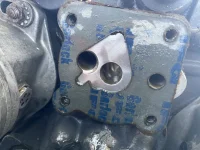
Ok, I need a little help here. Was trouble shooting today. I pulled the oil filter housing off to get the vernatherm out, and this is what I see.

5544F08C-DDC7-43D4-970F-C93B474F6C92.webp

The vernatherm is currently in the filter housing adapter, and the stock vernatherm port is plugged. My question is, is the vernatherm not in the WRONG location as it is? That valve seat inside the back of the case will never seal shut with the vernatherm in its current location. I think I need to plug the vernatherm port on the filter adapter housing, and move the vernatherm back to the original location. I don’t see any other way for the bypass to close and send oil through the cooler.

Where the vernatherm currently is:

4F37E9C2-6C5C-43E2-9419-D2C9A56D289F.webp

Where I think it should be:

1648F590-B463-4910-86F6-B1BF0CE72549.webp
Am I misunderstanding how this works?

Thanks for all the help!
 
Which filter adapter do you have and what do the installation directions say? If you read through it and it's not clear, I'd call the manufacturer of the filter adapter on Monday and ask them. You don't want to change something and be in non-compliance with the STC but it's entirely possible someone installed it incorrectly. If I had to guess, I'd say there's a seat for the vernatherm in the adapter with porting that allows the bypass to happen in the adapter but that's a guess, which I've been known to do. 😬
 
Which filter adapter do you have and what do the installation directions say? If you read through it and it's not clear, I'd call the manufacturer of the filter adapter on Monday and ask them. You don't want to change something and be in non-compliance with the STC.
It is Casper Labs. I’ll see if I can dig up the paperwork. I don’t think they’re in business anymore so it may be a bit of a wild goose chase trying to find that. My IA said he thinks the gasket is wrong as well. May end up having to get a new adapter if I can’t figure it out for sure. Yay airplane ownership.
 
Your Vernatherm is in the correct location. That upper plug you are showing is where the viscosity ball and spring would live IF you did not have a vernatherm..... One or the other, not both.

You have the correct gasket.... Casper uses a specific gasket. It seems to be correctly aligned, but you can confirm by just matching it to the adapter itself.
 
Last edited:
Your Vernatherm is in the correct location. That upper plug you are showing is where the viscosity ball and spring would live IF you did not have a vernatherm..... One or the other, not both.

Thanks for the insight...hard to track down good info since Casper seems to be out of business and no installation manuals are available online.

Good to know. So there is no valve "seat" with the current configuration. I was expecting to see a nice beveled edge where the vernatherm would seat when extended.

Sigh..... The trouble shooting continues. Yesterday, my IA and I replaced the oil cooler AND vernatherm. Temps came down a little but still above what I think they should be.

Next step is to examine the oil lines and routing, as the lines were replaced at the last annual, which is when the temp starting coming up.

I will also quadruple check the baffling, which is also new. Perhaps I need to stick a borescope in the hard/impossible to see places to just be absolutely sure it is sealing up properly.
 
FWIW, you can see where the old vernatherm has been seating on the non-beveled hole. That "wear ring" is consistent all around, indicating that it is seating correctly.

tempImagewG5j2j.webp
 
Casper is alive and well I believe.

New lines? check the inside of the line where the fitting goes into the rubber for a "flap". Its not unheard of when they are made that the fitting cuts the inside of the line making a flap, and blocking flow.
 
Back
Top