You are using an out of date browser. It may not display this or other websites correctly.
You should upgrade or use an alternative browser.
You should upgrade or use an alternative browser.
Considering Making a Citabria/Decathlon IFR
- Thread starter Mike Perun Jr
- Start date
AdamMorton
Member
I have also been considering a 7ECA as a primary/instrument trainer and time builder, since the IFR certification basis seems pretty solid, at least for the airplanes in my price range! Working a pros and cons list:
Pros:
All of that is going to cost at least $10k in just equipment cost. I don't know how much to install but i'd be pleasantly surprised if it was less than another 10k.
All this gets you an airplane this might be ok for training IFR procedures, but without an autopilot, pitot heat, alternate static... you wouldn't really want to be hanging out in IMC
Unfortunately, the cons seem to outweigh the pros for this mission...
Pros:
- 7ECAs are available for relatively short money
- The O-235 is great for fuel efficiency and the 2400 TBO is nice.
- Relatively good useful load for a 2 seater
- Not rubbing shoulders with your CFI in a tiny side-by-side cockpit
- Great visibility with windows on both sides of you
- Window opens! Door comes off (with STC)!
- Bonus training in tailwheel and light acro
- 50+ year old wood/fabric plane could be a money pit
- Might be hard to find a willing instructor, particularly for Instrument
- Visibility of instruments from back seat
- Could rig a battery powered webcam to a tablet mounted to the rear of the front seat to show a panel view to the back seat?
- Visibility of traffic from the back seat
- If you're in an area with high ADSB usage, a portable adsb-in and tablet could be used, but still an issue
- Cost to upgrade to IFR capable panel
All of that is going to cost at least $10k in just equipment cost. I don't know how much to install but i'd be pleasantly surprised if it was less than another 10k.
All this gets you an airplane this might be ok for training IFR procedures, but without an autopilot, pitot heat, alternate static... you wouldn't really want to be hanging out in IMC
Unfortunately, the cons seem to outweigh the pros for this mission...

donv
Well-known member
Citabrias are wonderful airplanes, and I love mine. As a CFI who has done some instruction from the rear seat, I can tell you that trying to use a Citabria for instrument instruction is just a bad idea. Buy one because they are a fun, inexpensive, very versatile little taildragger, yes. But don't expect it to do something that it was never intended to do.
Oh, and good luck finding an examiner willing to give you an instrument check ride in one!
Oh, and good luck finding an examiner willing to give you an instrument check ride in one!
Bob Turner
Well-known member
- Joined
- Apr 4, 2018
- Messages
- 4,196
Because none of them are tailwheel qualified. The airplane itself is an ok instrument platform, and the repeater screen idea is worth pursuing.
Ten grand is a little high unless you need really high end stuff. If you can do the installation yourself, five grand will do it. ADSB is not peculiar to taildraggers - if you need it, you need it. The Tailbeacon works just fine, and is cost-effective.
Assume you have a com and a transponder. You will need gyros, a KN 52 with glideslope, a vacuum source, an indicator, and that repeater TV system you are thinking about.
Ten grand is a little high unless you need really high end stuff. If you can do the installation yourself, five grand will do it. ADSB is not peculiar to taildraggers - if you need it, you need it. The Tailbeacon works just fine, and is cost-effective.
Assume you have a com and a transponder. You will need gyros, a KN 52 with glideslope, a vacuum source, an indicator, and that repeater TV system you are thinking about.
Bob Turner
Well-known member
- Joined
- Apr 4, 2018
- Messages
- 4,196
Correction: KN 53 with glideslope - $1295 today with paperwork on eBay. KI 208 indicator from Bennett (used) $700. Vacuum gyros are a grand each, but I bet good used ones are a dime a dozen with everybody going to G5’s. Does that help? I like the King stuff - trouble-free for 17 years in my Decathlon.
Oh - you will need an antenna splitter, and a”balun” on your antenna connection.
Oh - you will need an antenna splitter, and a”balun” on your antenna connection.

volvo164
Laszlo
- Joined
- Nov 18, 2019
- Messages
- 196
The 2 G5s & GNC355 was 22K for me. This was when other less expensive options were not yet available. I think it’s worth it if your looking to use it for cross country. No need for auto pilot - these planes get bounced around but not get upset in turbulence. I think they’re easy to fly IFR easier than hand flying my 172 that’s for sure. The slow speed is the biggest draw back. I commute between Boston and Philly and would not do a flight that’s IFR end to end, but have done trips that were VFR except for IFR departure or arrival. And often the best use case is to be able to safely do VFR trips in questionable wx, with a flight plan on file as a backup.
AdamMorton
Member
Correction: KN 53 with glideslope - $1295 today with paperwork on eBay. KI 208 indicator from Bennett (used) $700. Vacuum gyros are a grand each, but I bet good used ones are a dime a dozen with everybody going to G5’s. Does that help? I like the King stuff - trouble-free for 17 years in my Decathlon.
Oh - you will need an antenna splitter, and a”balun” on your antenna connection.
I was assuming that the cost to install the vacuum system in the first place (from an original vfr 7eca -- you may find an airplane that already has one) would make up for the somewhat higher cost of the electronic instruments. Also, you save a bit of weight.
AdamMorton
Member
Because none of them are tailwheel qualified. The airplane itself is an ok instrument platform, and the repeater screen idea is worth pursuing.
Ten grand is a little high unless you need really high end stuff. If you can do the installation yourself, five grand will do it. ADSB is not peculiar to taildraggers - if you need it, you need it. The Tailbeacon works just fine, and is cost-effective.
Assume you have a com and a transponder. You will need gyros, a KN 52 with glideslope, a vacuum source, an indicator, and that repeater TV system you are thinking about.
I'm still just a PPL student, so what do I know, but I can't imagine you would do an instrument rating in this day and age without GPS approaches?
volvo164
Laszlo
- Joined
- Nov 18, 2019
- Messages
- 196
IFR flying should not be lumped into one bucket. I also rent a FIKI certified A36. Of course I can tackle more serious weather with it. But to discount the usefulness of an IFR Citabria is silly. Ability to fly above an undercast instead of scud running below it, ability to confidently do trips with marginal weather, not get struck even on a long day trip because of unexpected change in weather, etc.
Bob Turner
Well-known member
- Joined
- Apr 4, 2018
- Messages
- 4,196
I believe an instrument checkride can be done with whatever is installed in the aircraft, so long as the installation meets the regulations. If you do not have DME, you cannot do a DME arc. That may have changed with ACS - I am scared to look.
Plus 1 for Laszlo's comment above.
I am using an 11" venturi for air, and all three instruments are vacuum. Above 60 mph they all work fine. Not good for icing conditions, but I can and do shoot ILS approaches with the vacuum air off. No gyros. Mine is a Decathlon, so no actual IFR allowed - but you bet if I needed to I could bring that thing down to 200 and 1/2.
If you think about it, isn't it better to learn on the antiquated stuff? Following a magenta line with full on weather and map on the screen then becomes child's play, and when it all quits you can go back to the basics successfully.
Plus 1 for Laszlo's comment above.
I am using an 11" venturi for air, and all three instruments are vacuum. Above 60 mph they all work fine. Not good for icing conditions, but I can and do shoot ILS approaches with the vacuum air off. No gyros. Mine is a Decathlon, so no actual IFR allowed - but you bet if I needed to I could bring that thing down to 200 and 1/2.
If you think about it, isn't it better to learn on the antiquated stuff? Following a magenta line with full on weather and map on the screen then becomes child's play, and when it all quits you can go back to the basics successfully.
AdamMorton
Member
I didn't even think about installing a venturi... and now I'm not sure what to think about that. Next you'll be suggesting a Champ with an air powered generator. 
I just checked the instrument ACS and it still looks like two unspecified non-precision and one precision approach is the requirement, which you could do as vor/dme, localizer, ILS... if you can find the right airports! GPS would definitely make one or two of them easier. But I do agree about learning the antiquated stuff-- one good solar flare could cook the whole GPS system, and one war might make them shut it off.
I just checked the instrument ACS and it still looks like two unspecified non-precision and one precision approach is the requirement, which you could do as vor/dme, localizer, ILS... if you can find the right airports! GPS would definitely make one or two of them easier. But I do agree about learning the antiquated stuff-- one good solar flare could cook the whole GPS system, and one war might make them shut it off.
donv
Well-known member
You don't want vacuum powered instruments in a Citabria. Mine had a vacuum DG and AI when I got it, neither worked (which is normal for an aerobatic airplane which does even light aerobatics), and I junked the whole system, vacuum pumps and all. If you are going to do it, get an Aspen or a couple of Gamin G5s and do it the right way-- it will be cheaper in the long run.
But don't even bother with doing your instrument in the Citabria. You will have a very hard time finding an instructor, let alone an examiner. I have found that it is better to go to a school which trains people regularly and do their approved, regularly used and updated, curriculum in the airplanes they have and know.
But don't even bother with doing your instrument in the Citabria. You will have a very hard time finding an instructor, let alone an examiner. I have found that it is better to go to a school which trains people regularly and do their approved, regularly used and updated, curriculum in the airplanes they have and know.
volvo164
Laszlo
- Joined
- Nov 18, 2019
- Messages
- 196
You also need to think about your workflow in the cockpit. It is more of challenge than 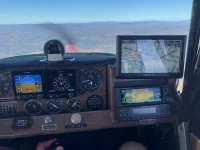
a Cessna with a yoke. No seat next to you to place an ipad / map. Not many places to mount it either. After years of taking minutes to enter a waypoint by twisting knobs on a 430, the newer touchscreen GPSs make IFR flight plan management a breeze. Above is my setup. I'll also use an iPad on a knee strap, but mainly as a backup and not primary. I work with the iFly gps for charts, approach (arrival, departure) planning, and viewing the charts, and the GPS355 would just be on the flight plan page. I'm huge fan of iFly for it's flying oriented interface (vs. planning oriented for Foreflight), customization, and that it runs on my iPad, iPhone and a dedicated hardware device (without worries of overheating, pressure touchscreen instead of capacitive, and great visibility). I removed my VOR receiver - no need, and saved weight. By the way, for the checkride, they accept an LPV approach as a substitute for a precision approach. I just miss a second radio for backup - and cross my finger that they'll hear me on my portable. Good workflow (and the plane's inherent stability) mitigates the need for an autopilot. I hate working off my lap for IFR, looking down and up is disorienting, and it takes you just a bit longer to find what your looking or on the ipad on your lap as well. Here, I've got my right hand free to manage all tasks, with an easy scan. I actually prefer the side by side G5 setup. Were I to do this now, I would go with the uAvionix stuff to save $. Although the G5 HSI is really nice. You can indeed save further weight with units that are TSO'd instead of STC'd, which would allow you to ditch the steam gauges - except that I find the steam gauges both useful (easier to monitor) and comforting for backup. The 7ECA is a great cross country plane: with metal spars, it's over 600 lbs useful load, 5 hours + reserve range, comfortable and stable. I like the way it rides turbulence vs. being shaken in aluminum airframes. Controllers are puzzled about it - I often get called out as a helicopter to other traffic ...
a Cessna with a yoke. No seat next to you to place an ipad / map. Not many places to mount it either. After years of taking minutes to enter a waypoint by twisting knobs on a 430, the newer touchscreen GPSs make IFR flight plan management a breeze. Above is my setup. I'll also use an iPad on a knee strap, but mainly as a backup and not primary. I work with the iFly gps for charts, approach (arrival, departure) planning, and viewing the charts, and the GPS355 would just be on the flight plan page. I'm huge fan of iFly for it's flying oriented interface (vs. planning oriented for Foreflight), customization, and that it runs on my iPad, iPhone and a dedicated hardware device (without worries of overheating, pressure touchscreen instead of capacitive, and great visibility). I removed my VOR receiver - no need, and saved weight. By the way, for the checkride, they accept an LPV approach as a substitute for a precision approach. I just miss a second radio for backup - and cross my finger that they'll hear me on my portable. Good workflow (and the plane's inherent stability) mitigates the need for an autopilot. I hate working off my lap for IFR, looking down and up is disorienting, and it takes you just a bit longer to find what your looking or on the ipad on your lap as well. Here, I've got my right hand free to manage all tasks, with an easy scan. I actually prefer the side by side G5 setup. Were I to do this now, I would go with the uAvionix stuff to save $. Although the G5 HSI is really nice. You can indeed save further weight with units that are TSO'd instead of STC'd, which would allow you to ditch the steam gauges - except that I find the steam gauges both useful (easier to monitor) and comforting for backup. The 7ECA is a great cross country plane: with metal spars, it's over 600 lbs useful load, 5 hours + reserve range, comfortable and stable. I like the way it rides turbulence vs. being shaken in aluminum airframes. Controllers are puzzled about it - I often get called out as a helicopter to other traffic ...
Bob Turner
Well-known member
- Joined
- Apr 4, 2018
- Messages
- 4,196
Again, you do not need iPads and glass cockpits for initial instrument work. Learn to do without. Find a place to clip your chart.
Probably not legal, but I keep the air off my gauges unless practicing approaches. Makes the gauges last a lot longer. They do not like inverted flight.
Probably not legal, but I keep the air off my gauges unless practicing approaches. Makes the gauges last a lot longer. They do not like inverted flight.
volvo164
Laszlo
- Joined
- Nov 18, 2019
- Messages
- 196
Bob - I agree - my comment was for actual IFR flying in IMC. Other than an IFR let down through a layer, I wouldn't venture out without at least an IFR GPS - and my point was the newer stuff makes it easy to manage even in a plane like ours, with a stick, no autopilot, etc. For learning - absolutely. My kids are learning in a club C150 that only has 2 NAV coms. In many ways that's the ideal platform to learn. But I would much rather take my plane into IMC than that one.

you do not need iPads and glass cockpits for initial instrument work. Learn to do without.
I agree. Situational awareness isn't developed my looking at a magenta line, it happens by imagining the radials you're intercepting or (God forbid!) the bearing to or from a station that you are trying to maintain. If you can't put the elements together in your head and make sense of it up there, it's hard to imagine what the outcome might be if you lost a moving map display and had to revert to more basic methods. And that's always on the table, a failure that degrades your navigational performance will happen and you must be able to accommodate it and carry on safely or at least divert safely to an alternate or back to your departure airport.

darrell whitley
Well-known member
I learned the old fashion needle, ball, airspeed way. It’s a lot different now. 
Bob Turner
Well-known member
- Joined
- Apr 4, 2018
- Messages
- 4,196
We had proposed a patch for our leather jackets - and yeah, after I retired the company allowed them. Dark blue!
The patch? "Why did it do that?"
The obvious answer - "Who cares? Turn that stupid stuff off and fly the airplane!"
The scenario - night, single pilot, light rime ice, turning on to the localizer, slightly above the glide slope, and you reach up to engage the capture button, hitting just the wrong thing, and the screen goes into checklist mode and returns your comm frequency to who knows what? It is at that point that you cease trouble shooting and revert to the standby instruments for the approach. Good luck to you if you never hand fly raw data approaches.
On the hand held - unless that sucker is already hooked up to a decent antenna, and ready for use with a simple frequency entry (not likely on the more recent offerings) you are safer to look out the window and not hit anybody or anything while waiting for the green light.
One of my students got the whole airport shut down last year while he fumbled with his rather esoteric hand held - he wasn't looking out the window, or he would have seen the green light. The tower and I both had a conversation . . .
I have lots of experience with electronics - I even programmed a computer in ones and zeroes in the 1970s - but the newer Icom handhelds are literally beyond my level of basic understanding. They have more storage bins than there are frequencies to store - nobody needs more than 16. If the engineers who build these things had to fly with them they would have a button called memory, and another called "type in the frequency you need and hit enter" or something. Instead, you have to guess, while everybody gives way to the nordo on downwind.
The patch? "Why did it do that?"
The obvious answer - "Who cares? Turn that stupid stuff off and fly the airplane!"
The scenario - night, single pilot, light rime ice, turning on to the localizer, slightly above the glide slope, and you reach up to engage the capture button, hitting just the wrong thing, and the screen goes into checklist mode and returns your comm frequency to who knows what? It is at that point that you cease trouble shooting and revert to the standby instruments for the approach. Good luck to you if you never hand fly raw data approaches.
On the hand held - unless that sucker is already hooked up to a decent antenna, and ready for use with a simple frequency entry (not likely on the more recent offerings) you are safer to look out the window and not hit anybody or anything while waiting for the green light.
One of my students got the whole airport shut down last year while he fumbled with his rather esoteric hand held - he wasn't looking out the window, or he would have seen the green light. The tower and I both had a conversation . . .
I have lots of experience with electronics - I even programmed a computer in ones and zeroes in the 1970s - but the newer Icom handhelds are literally beyond my level of basic understanding. They have more storage bins than there are frequencies to store - nobody needs more than 16. If the engineers who build these things had to fly with them they would have a button called memory, and another called "type in the frequency you need and hit enter" or something. Instead, you have to guess, while everybody gives way to the nordo on downwind.
If the engineers who build these things had to fly with them they would have a button called memory, and another called "type in the frequency you need and hit enter" or something. Instead, you have to guess, while everybody gives way to the nordo on downwind.
that's pretty funny!
and it isn't just the failure rate of modern electronics which is near zero, it's the failure rate of old Cessna windshields in rain showers that can do in the best of panel mounted gadgetry and other not so predictable scenarios like that.
darrell whitley
Well-known member
Amen Bob. Back in the day they used to turn off the FD and just fly. Then they put it in the manual that u had to have both FD’s up to shoot an approach less than 4000rvr or 3/4 of a mile. And a working AP.