Parachutes in Citabrias and Decathlons

Got my seat chute today. Big improvement. Pirep follows:

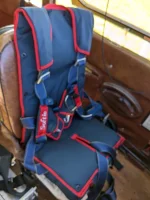
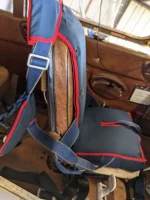
My model is the Paraphernalia Softie Seat Wedge. It is a square seat pack. The wedge refers to the front of the pack being thicker than the rear. The difference is not pronounced, less than an inch, and I don't think makes a difference in fit or comfort. It may help push your hips rearward and make you feel more secure, but I would have to sit on a flat seat pack to compare.

I did do a comparison with my back pack chute, and IMO the seat chute is better. With my adjustable Decathlon seat at the rear stops and the back cushion removed, the back chute just pushes me too far forward, to the point where I notice my fingers pressing on my lap belt at full aft stick deflection.

With the seat pack, my hips are at least 2 inches further aft. I did not notice any interference with full aft stick deflection. The back lining of the chute has 1/2 foam, so I could probably remove the back cushion from the seatback and get another inch to the rear.

Of course there is no free lunch, and the seat pack does result in a higher posture. At first it felt a bit odd, but I got used to it quickly. There was plenty of clearance over my head. The biggest difference was ridiculous forward visibility on the runway.

I wanted the Softie Citabria seat pack, which is 17" wide in front and 13" wide in the rear, to 'fit' better than the standard 15" seat pack. After test fitting my new square pack, I'm glad I did not wait. This one fits fine. The seat bottom is flush with the frame, so the only area where fit matters is between the seatback hinges. The distance between the hinges is 16", so the 15" wide seat pack fits just fine. I did flip my hinge bolts around with the castle nuts outward, so the cotter pins would not snag the chute case.

Mine has the Aerobatic Harness, which has 2 snaps up on the stomach instead of a chest strap and 2 snaps at the hips like to a standard harness. I was not looking for this type harness, but now that I have it, I am am really glad I got it. Moving the leg strap hardware up off the hips allows you to crank the seatbelts down good and tight without interference.
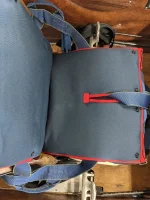
PXL_20210928_205855074.jpgPXL_20210928_195402912.jpgPXL_20210928_195348011.jpg
 
Last edited:
Like someone once said..."hopefully you use your parachute for nothing more than sitting on while flying (upside down)". I wore a parachute when flying gliders. One thing I was made aware of by another glider pilot (who had bailed out after a mid-air with another glider in a thermal) was to have a planned "sequence" on your exit from the aircraft so thing don't get tangled up. I practice exiting my 7KCAB with my chute on (I have a friend hold the door when I pull the ring on the emergency release). Just my $0.02.
 
Yup, I mentally rehearse before every acro flight, and physically rehearse afterwards. POWER - DOOR - HEADSET - BELTS. I don't pull the pin on the door, I just slap the ring and lever.
 
Ed - thanks for the pirep on the seat pack. I am looking at them myself. Do you strap on the chute before getting into the plane for do you lay it on the seat as shown in your photos and then slide into it as you climb in?
 
Ed - thanks for the pirep on the seat pack. I am looking at them myself. Do you strap on the chute before getting into the plane for do you lay it on the seat as shown in your photos and then slide into it as you climb in?

The latter, though some advise against it.

Leaving the chute in place and strapping in after getting seated saves a ton of time. Usually I taxi to the runup area, then strap in while my engine is warming up. My hangar is 50 feet from the departure end of the runway, so I can be cranked and in the air in 5 minutes. Usually I am staring at the Oil Temp needle waiting for it to move.

It also saves wear and tear on the chute. The folding front seat frame hinge bracket has some metal edges that abrade the chute when you try and get in or out with it.

Misrouting the straps is a concern. I fly several times a week so I have a pretty good routine down. I am in the process of ordering a Hooker seat harness with contrasting colors, which should reduce the odds of getting the two confused. Dark blue for the chute straps, bright gold for the seatbelt.
 
The latter, though some advise against it.

Leaving the chute in place and strapping in after getting seated saves a ton of time. Usually I taxi to the runup area, then strap in while my engine is warming up. My hangar is 50 feet from the departure end of the runway, so I can be cranked and in the air in 5 minutes. Usually I am staring at the Oil Temp needle waiting for it to move.

It also saves wear and tear on the chute. The folding front seat frame hinge bracket has some metal edges that abrade the chute when you try and get in or out with it.

Misrouting the straps is a concern. I fly several times a week so I have a pretty good routine down. I am in the process of ordering a Hooker seat harness with contrasting colors, which should reduce the odds of getting the two confused. Dark blue for the chute straps, bright gold for the seatbelt.

Minor point maybe, but per 14 CFR 91.107(a)(3):

(3) Except as provided in this paragraph, each person on board a U.S.-registered civil aircraft (except a free balloon that incorporates a basket or gondola or an airship type certificated before November 2, 1987) must occupy an approved seat or berth with a safety belt and, if installed, shoulder harness, properly secured about him or her during movement on the surface, takeoff, and landing.

Which means if you taxi to your warm up area without the seat belt and shoulder harness fastened it’s a violation. If you do that on a check ride, it’s an automatic bust and if someone from the Friendly Aviation Administration sees you do it, it’s likely to result in a letter.

I‘m not mentioning it to sway you one way or the other, but rather just to make the point that it’s a potential violation if you move the aircraft over the ground with the belts and shoulder harnesses unfastened, so that anyone lose reading this can make an informed decision.

——

My usual method is to start the aircraft and then (while staying on the brakes and ensuring the throttle doesn’t get bumped) put on the five point harness while the engine warms up. Since I prefer a back mounted parachute I‘ve already got the parachute on.

On a check ride and/or with impressionable students it‘s belts and suspenders time, getting everything strapped before I start the engine.
 
Last edited:
How long do you “warm it up”???? Okay I saw 5 minutes

The Lycoming manual says it’s warm enough to take off when it doesn’t hesitate when the throttle is advanced.

I’m not a big fan of that method. Like Big Ed, I usually wait for the oil temp to get off the peg, indicating at least 80 degrees or so. I also look for CHTs of at least 240 degrees.
 
  • Like
Reactions: els
Hmmm my procedure is to put the hooker on then start the engine. But that’s just me.
I look at the CHT too. I usually wait 7 to 10 minutes.

I fasten the lap belt, start up, taxi to the runup area, set the parking brake, then undo the lap belt and start the more involved process of routing the chute harness, fastening and tightening the 5 point harness, and refastening the lap/shoulder belt. That plus runup usually consumes 5-7 minutes.

I don't have a CHT. Wish I did. Bar graph GEM is on the wish list. Maybe I should throw in an old analog single CHT while I wait. Any idea which cylinder is hot?
 
I fasten the lap belt, start up, taxi to the runup area, set the parking brake, then undo the lap belt and start the more involved process of routing the chute harness, fastening and tightening the 5 point harness, and refastening the lap/shoulder belt. That plus runup usually consumes 5-7 minutes.

I don't have a CHT. Wish I did. Bar graph GEM is on the wish list. Maybe I should throw in an old analog single CHT while I wait. Any idea which cylinder is hot?

I have an EDM 700 in mine, Number 3 is always about 7-10 degrees warmer than number 4. Cylinders 1 and 2 are usually 10-15 degrees cooler than number 4.

On my 0-320 powered PA-22/20-150 Piper put the CHT probe on number 4, so apparently they felt that cylinder ran hotter.
 
I’m trying to decide whether to order a seat chute or backpack chute, so this thread is helpful. I’ve never worn either so it’s hard to decide which I’d prefer. Both the seat back and the bottom cushions are removable in my ‘76 8KCAB so I think I could go either way.

By the way, when I removed the bottom cushion today I discovered an adjustment mechanism under it. Seem like it’s designed to be pull a spring bolt out of the holes in a tube but when I do that the seat does not move. Is it supposed to?
 
I’m trying to decide whether to order a seat chute or backpack chute, so this thread is helpful. I’ve never worn either so it’s hard to decide which I’d prefer. Both the seat back and the bottom cushions are removable in my ‘76 8KCAB so I think I could go either way.

By the way, when I removed the bottom cushion today I discovered an adjustment mechanism under it. Seem like it’s designed to be pull a spring bolt out of the holes in a tube but when I do that the seat does not move. Is it supposed to?

All personal preference and body type. From the discussion I've seen, votes run about 50/50 so you can't go wrong. IMO the Decathlon has plenty of headroom but limited rearward stick travel, so I prefer a seat chute.

Yes, you have an adjustable seat. Pull the handle and the seat frame should pivot fore and aft on the legs. Mine barely moved when I got it. 40 years of gunk inside. I eventually took it apart and cleaned it out real good. If you do that, you gotta take that stupid Y apart to get it back in the aircraft. Will drive you crazy trying to compress the spring otherwise.

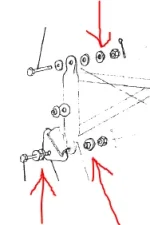
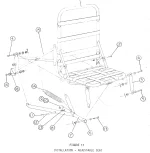
Check the attachment points where the legs fasten to the frame. There should be bushings that keep the parts from being clamped together, so the legs can pivot freely around the bolts, and so the seat belt attachment points can rotate freely. See red arrows on the diagram below. They tend to get lost over time, and someone just stacks some washers together to fill the space. ACA has them.

bushings.webp

seat.webp
 
I bought my '75 8KCAB back in September of 2021. It came with two Strong Enterprises model 304 Para-cushion parachutes. Original manufacture date was March, 2018. Repack date (on Data Card) was March 2019 - 180-days out of the FAA required inspection/repacking period. Although Strong manufactures their chutes for a 360-day repack cycle, the FAA requires emergency parachute inspection/repack every 180-days. So now, I had two chutes approaching three-years since inspection/repack.

To avoid chasing-down a Rigger that would inspect and repack an out-of-date emergency parachute(s), I decided that the best route would be to send the chutes to Strong to sign-off on the chutes. My thinking is that the next Rigger would be more comfortable providing their services being that the manufacturer gave the chutes a clean bill of health.

$70 per chute charge, turn-around was less than two-weeks. Yes, shipping charges left a mark.

My chutes are seat-style, and 3" thick. Strong does offer Travel Cushions (seat bottom pads) from 1" to 6". I'm still trying to figure out how thick I want the cushion to be.
 
Back
Top