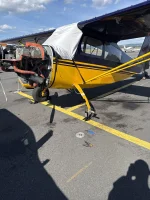
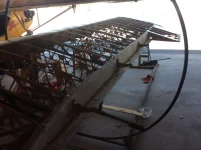
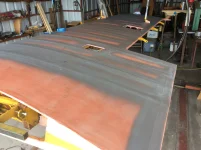
What did you do to your bird today?

Technically, Ray Stitts first procedure manual is still valid. I covered my Cub with that in 1969, and that alteration is legal on my aircraft to the end of time or an AD is issued. I can use any topcoat I want.

(This interesting tidbit is brought to you by the Administrative Procedures Act, which, admittedly, might be found unconstitutional before the Roberts court is finished.)

If you read just the excerpt above, it pertains only to lacing, not pop rivets. Without going to the manual, let me guess that somewhere else it states that you also adhere to the manufacturer's method of attachment?
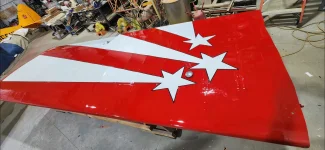
 
I have an older pf manual as well, and with that I can use a top coat of my choice. I wouldn't, precisely because isocyanide coatings just keep getting more brittle as time goes by, guys were shooting imron, and that stuff is super hard, standard auto paint is just as hard and pop-able as old dope.... however it doesn't shrink over time like dope does.
Consolidated coatings reformulated their aerothane formula (before 2000's) and chemically designed it from the jump as a flexible paint.... not like adding a flex agent.
Let me tell you, its a lot different than the old formulation.
Anyway im pretty sure that the old books use is the situation with cc and aviat. However i have heard recently (through the grapevine) that cc has been told not to.
As far as what aca does with the glass tape, this wing didn't have any. After my personal experience looking at this wing and that last citabria wing, I wouldn't use the aca process.
If I was told I had to use the aca process you can bet your pretty pink bippy id have all the paperwork in order to support it.
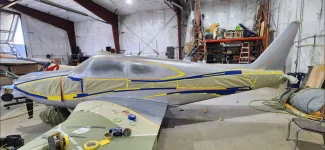
Anyway I got the pinstripping down today. Screenshot_20260702_144728_Gallery.webp
 
AI is your friend…

citabria polyken - Google Search​

  • Purpose: Acts as a protective barrier (antichafe) between the airframe's aluminum cross-ribs/rivets and the aircraft's dacron fabric covering to prevent the fabric from "drumming" or wearing through.
  • Factory Specs: Factory uses Boeing cargo hold friction tape, Polyken 296FR. It is a thin, flame-retardant fiberglass cloth tape that meets FAA flammability spec FAR 25.853 and FAR 25.855.
  • Application Method: Unlike traditional adhesive tapes, this modern reinforcement tape requires pre-coating the fabric with an adhesive (such as 3M 30-NF Contact Adhesive) because the tape's self-adhesive backing does not securely grip the bare aircraft fabric naturally.
While Polyken tape is used for rivet protection, the overarching covering system for the Citabria usually falls under the Poly-Fiber Covering System or the Ceconite process. When completing a full recover or repair, restorers use specific Poly-Fiber finishing tapes and adhesives over the airframe structure rather than standard Polyken products for the main fabric seams.
 
Polyken chafe tape.... used under covering, for anti chafe... not the same as rib lace/rivet reinforcement tape. While aca uses it under the rivets, I would not as i am not a TC or PMA holder. On a certed airframe I'm held to abide by the stc as required by the covering system used.

Honestly its my personal opinion that the best possible anti chafe available as of right now is oratex. Its easy, its bulletproof, and damnear foolproof, its just not sat to go under any other covering system. Its ok to patch any system with it though.
 
On the factory system - if they publish what it is, then you can use it as a major repair. Last I heard it was totally different from Polyfiber.
The auto enamels do need flex agents. The guys at Airtec add them to their urethanes, but did mention "Evolution" (I think -it has been four years) as a good coating. We had the talented folks in Santa Maria shoot the top coat and it still looks new.

I personally am going to stick with Poly Tone for now - not quite as shiny, but I have learned how to spray it so it doesn't look flat.

But this is a good conversation. It really would be a good thing to nail down (so to speak) the approved methods for reinforcing under pop rivets. Maybe it wasn't important for earlier Champs, but these new Decathlons can put twice the force on the reinforcing tape.
 
and
But this is a good conversation. It really would be a good thing to nail down (so to speak) the approved methods for reinforcing under pop rivets. Maybe it wasn't important for earlier Champs, but these new Decathlons can put twice the force on the reinforcing tape.
Agree, I love the subject. Evolution is a direct response to aerothane. The twill reinforcement tape is a polyfiber must, even under rivets. I too soak it with brush before punching it for rivet install... I prefer punching (with a sharp narrow awl) over melting it, this way it shoves the fibers sideways instead of eliminating them.
Ive seen and repaired too many aca, cc, and aviat top coats.... all because auto paint with or without flex agent sucks..... eventually.
I respect anyone that prefers polytone... Its not my preference just because it sucks to keep it clean, at a minimum id shoot the belly with aerothane.
Lastly with the advent of oratex patch swatches there isn't a need to remove aerothane to the silver to repair, so ease of repair is now a thing with aerothane.... stick the patch on, stretch it and paint it ..... done. Takes me lest than an hour.
 
I think some systems allow you to scuff the outer coat and glue directly to that. The fact that Oratex is legal that way would lead one to think the top coat could hold a repair.

Good idea on the awl - on the few pop rivet repairs I have done that was what I did.

Another idea is an electric pop rivet puller - Milwaukee makes one. Amazing how much faster . . .
 
AI is your friend…

citabria polyken - Google Search​

  • Purpose: Acts as a protective barrier (antichafe) between the airframe's aluminum cross-ribs/rivets and the aircraft's dacron fabric covering to prevent the fabric from "drumming" or wearing through.
  • Factory Specs: Factory uses Boeing cargo hold friction tape, Polyken 296FR. It is a thin, flame-retardant fiberglass cloth tape that meets FAA flammability spec FAR 25.853 and FAR 25.855.
  • Application Method: Unlike traditional adhesive tapes, this modern reinforcement tape requires pre-coating the fabric with an adhesive (such as 3M 30-NF Contact Adhesive) because the tape's self-adhesive backing does not securely grip the bare aircraft fabric naturally.
While Polyken tape is used for rivet protection, the overarching covering system for the Citabria usually falls under the Poly-Fiber Covering System or the Ceconite process. When completing a full recover or repair, restorers use specific Poly-Fiber finishing tapes and adhesives over the airframe structure rather than standard Polyken products for the main fabric seams.
It probably got that from our posts here, it’s been covered a few times
 
It probably got that from our posts here, it’s been covered a few times
Yes, saw your post from 2022. You mentioned putting 2” ceconite tape over the 1” wide 296FR. I could only find 2” wide rolls online but never thought to go direct ACA.
 
Yeah, you do not want Ceconite tapes under the rivets, for reasons outlined above.

I am looking for my Stits manual - probably at the airport. Here is a Goldenbaum quote (with my emphasis). It is is not really in a procedure manual, but I bet something like it is in most manuals:

If you're working on a certified aircraft, the method you use to secure the wing fabric to the wing ribs should be the same one they used at the factory when your aircraft was manufactured. It you want to use a different method, you'll have to get a field approval from the FAA. You're better off just doing what the factory did.

When Stits addresses rib stitches, he is not addressing pop rivets or Martin Clips. I believe we are really constrained here. That said, a beautiful repair job just came back from Corona, using the 1/2" Stits tape with pop rivets. No question that it will work just fine, but one can wonder about the legality?

I don't have a working relationship with ACA, but several of you do - what do they say about the Stits 1/2" tape?

As an aside - I have found it to be Stitts on several Poly Fiber publications, but would like to use the spelling that Ray used. The editor does not like Stits, but has no trouble with Stitts. Anybody know for sure? It is possible I have a letter from Ray somewhere, but my filing system sucks.
 
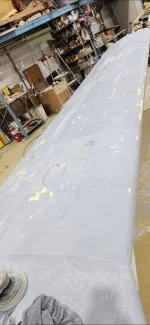
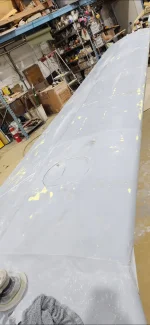
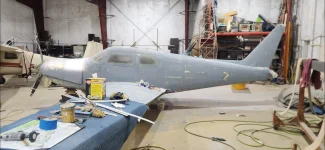
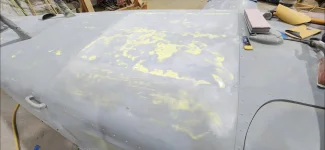
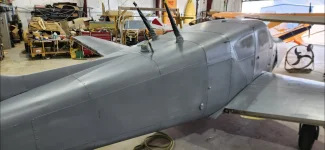
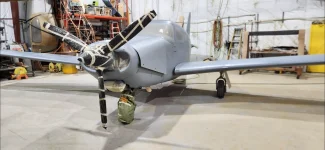
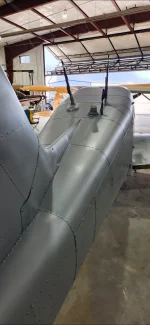
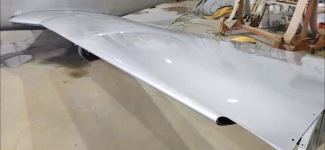
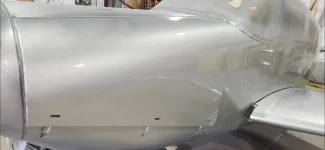
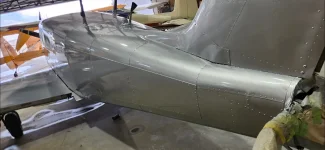
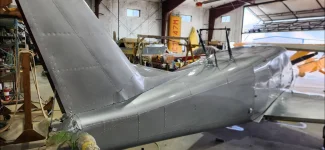
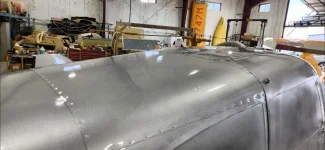
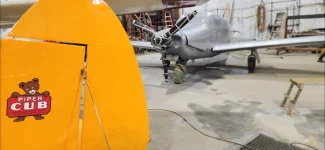
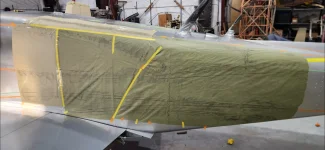
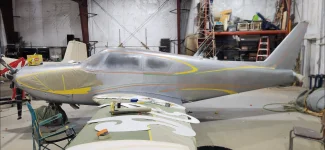
This bird was stripped, prep coated, primed with epoxy primer, then shot with single stage urethane. Then I let it cure and did other stuff. The base layer of urethane is an aerothane, its engineered with flexi in mind. It was from my bucket of dump paint. Its all cured up, about 2 weeks ago I started fairing / true-ing it up, sanding out orange peel and repairing minor issues here and there.... two weeks of hot grungy work, I love sanding, however I prefer it during spring fall and winter more..... the swamp A$$ is real. eek.gif
Anyway, today I got to win a little..... I got to shoot sealer and it went on smoothly, even in the heat. biggrin.gif
The pics show the amount of true-ing the thing took... today was a 12 hour day.... tomorrow I get to shoot the silver base coat, but only after a scuff with 800 and yet another clean-wipe down cycle.
When guys ask what a paint job costs, and then freak out when I tell them, well let's just say that guys think you just clean and shoot....
Done correctly, you literally massage the paint on .... shooting is the reward that only comes after a mostly insane amount of prep....
Oh and I hit the refrigerator stationed water filter for about 3/4 of a gallon of water and electrolyte.Screenshot_20260728_182028_Gallery.webpScreenshot_20260728_182008_Gallery.webpScreenshot_20260728_181953_Gallery.webpScreenshot_20260728_181841_Gallery.webpScreenshot_20260728_181846_Gallery.webpScreenshot_20260728_181834_Gallery.webp
 
Last edited:
Back
Top